
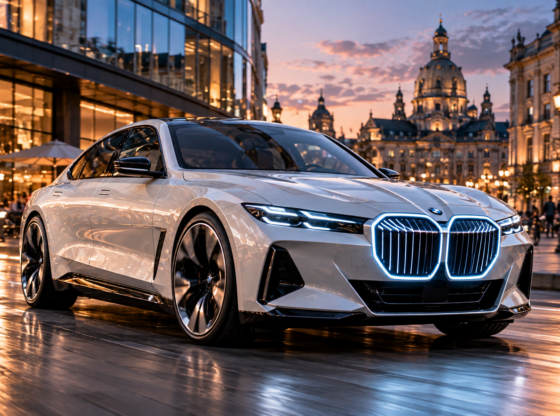

The electric-car story is moving into another busy phase. Some of the most important models announced during 2026 are now reaching production, while others are preparing for showroom launches that will continue into 2027. For manufacturers, these cars are more than additions to existing lineups. They are opportunities to prove that electric vehicles can combine longer range, faster charging, better packaging and familiar driving characteristics without becoming prohibitively expensive.
The new BMW i3 is one of the clearest examples. Series production began in Munich in August 2026, marking the arrival of the second model built on BMW’s Neue Klasse architecture. The company is promising up to 900 kilometres of WLTP range, 800-volt electrical architecture and charging at up to 400 kW.
At the same time, Toyota is preparing the three-row Highlander BEV for its North American launch, expected toward the end of 2026, while Hyundai has introduced the IONIQ 3 as a compact electric hatchback aimed at everyday European driving.
Together, these launches show that the next generation of EVs will not be defined by one universal formula. Manufacturers are approaching electrification through different combinations of range, vehicle size, charging capability, practicality and price.
BMW i3 Brings the 3 Series Into a New Electric Era
Few electric launches in 2026 carry as much symbolic weight as the new BMW i3.
The name is familiar, but the car is completely different from the small electric hatchback that BMW sold under the same badge in the previous decade. The new i3 is an electric sports sedan based on the Neue Klasse architecture and positioned as the battery-powered counterpart to the latest BMW 3 Series generation.
BMW says the new model can achieve up to 900 kilometres on the WLTP cycle, depending on specification. Its sixth-generation eDrive technology uses an 800-volt system, while maximum DC charging power reaches 400 kW. Under the company’s stated conditions, ten minutes of charging can add enough energy for up to 400 kilometres of WLTP range.
Those numbers put the i3 among the most ambitious new electric sedans in terms of range and charging performance.
The technical specification is also important because BMW is not presenting the car as a technology experiment. Series production started at the company’s Munich plant in August, and the factory is being transformed into an exclusively electric production site from 2027.
That makes the i3 part of a much larger industrial transition. BMW is effectively using one of its most historically important manufacturing locations to demonstrate how the company intends to build its next generation of electric vehicles.
A Familiar Name With a Completely New Mission
The new BMW i3 also illustrates how established automotive identities are changing.
The original i3 was deliberately unconventional. Its carbon-fibre construction, tall body and unusual proportions made it look unlike a traditional BMW. The new model takes almost the opposite approach. It is recognizably a premium sports sedan, but the technology underneath is designed specifically around electric propulsion.
That distinction matters because electric cars are gradually becoming less dependent on futuristic styling to communicate that they are different. The new generation can look like a conventional sedan, SUV or hatchback while using a fundamentally different powertrain.
BMW’s latest 3 Series range makes this transition particularly visible. The electric i3 is being introduced alongside versions using petrol engines and 48-volt mild-hybrid technology. Orders for the new generation opened at the end of September 2026, with first deliveries expected around the turn of the year.
For buyers, that means the choice of powertrain can increasingly become a decision within the same model family rather than a decision between completely different vehicles.
Toyota Takes Electric Mobility Into the Three-Row SUV
While BMW is concentrating on a premium sports sedan, Toyota is expanding in another direction.
The company premiered the three-row Highlander BEV in February 2026, with sales in North America expected to begin toward the end of the year. Toyota describes the vehicle as part of its broader effort to expand its battery-electric lineup while continuing its multi-pathway strategy.
The importance of this model is its size and intended role. A three-row electric SUV is designed for families and longer journeys, where interior space, luggage capacity and everyday practicality can matter as much as acceleration or maximum charging power.
That makes the Highlander BEV an important test for the broader EV market. Electric vehicles have already become common in compact and premium segments, but larger family vehicles place greater demands on battery capacity, efficiency and overall packaging.
Toyota has also been expanding its electric SUV range in other markets. The bZ4X Touring, launched in Japan in February 2026, was developed around the idea that an electric vehicle should be practical for family leisure and outdoor use, with additional luggage space and greater versatility than the original bZ4X.
The direction is clear: Toyota is trying to make electric vehicles fit into the routines of people who need substantial space rather than asking customers to change their lifestyles around the limitations of an EV.
Hyundai Moves the IONIQ Family Down the Size Scale
Hyundai is approaching the next stage from another angle.
In April 2026, the company introduced the IONIQ 3, a fully electric compact hatchback designed specifically around everyday European driving requirements. Hyundai describes it as an “Aero Hatch”, using a streamlined body shape to balance aerodynamic efficiency with interior space.
The model is significant because compact electric cars are becoming increasingly important to the industry’s next phase. Large batteries and premium SUVs can demonstrate impressive technology, but smaller vehicles are crucial if manufacturers want EVs to reach a much wider group of drivers.
Hyundai’s approach also reflects a broader change in vehicle design. Aerodynamics are no longer being treated simply as a way to improve a car’s efficiency at high speed. The shape of the vehicle is becoming part of the overall packaging strategy, allowing designers to reduce aerodynamic drag without necessarily sacrificing passenger space.
The IONIQ 3 therefore belongs to a growing generation of EVs that are designed from the beginning around efficiency rather than adapting an existing combustion-engine vehicle to electric power.
The Electric Hilux Shows How Far Electrification Is Expanding
Another notable example comes from Toyota’s electric Hilux.
The battery-electric version of the pickup was unveiled as part of the latest Hilux generation, with Toyota planning a sequential rollout from 2026 onward. The prototype specification uses a 59.2 kWh lithium-ion battery and targets more than 300 kilometres of range, while front and rear e-axles provide a maximum system output of 144 kW.
Those numbers are not intended to compete with the longest-range passenger EVs. Instead, the electric Hilux is designed around the requirements of a working pickup, where traction, durability and off-road capability can be more important than achieving an exceptional highway range figure.
That distinction highlights an increasingly important feature of the EV market: the best specification depends on the vehicle’s purpose.
A compact hatchback needs low energy consumption and manageable dimensions. A family SUV needs space and range. A sports sedan needs power and rapid charging. A pickup needs torque, traction and a powertrain capable of operating in demanding environments.
The next generation of electric cars is beginning to reflect these differences more clearly.
Batteries Are Becoming More Closely Matched to the Vehicle
The new models also reveal how manufacturers are becoming more deliberate about battery size.
For years, increasing battery capacity was one of the simplest ways to improve an EV’s range. The problem is that larger batteries add weight, cost and material requirements. Modern manufacturers are therefore trying to improve the entire vehicle rather than simply installing a bigger battery.
BMW’s i3 is a good example. Its 900-kilometre WLTP target is not based solely on an enormous battery. The company has combined a new battery architecture with improved electric motors, aerodynamics, electronics and vehicle efficiency.
Toyota is pursuing a similar philosophy from a different technological direction. The company has said that its next-generation BEVs will use new battery technologies alongside improvements in aerodynamics and weight reduction. Its planned performance battery was designed around a target range of up to 1,000 kilometres, while a lower-cost LFP-based battery is being developed for more affordable vehicles.
This suggests that future EV lineups may contain several distinct battery strategies rather than one standard technology.
Charging Speed Is Becoming Part of the Vehicle’s Identity
The new generation is also changing expectations around charging.
A high charging rate can reduce the practical importance of battery size because drivers can recover a large amount of range during a relatively short stop. BMW’s 400-kW capability is therefore not simply a technical specification. It changes how the vehicle can be used on long journeys.
Other manufacturers are approaching the problem differently. Toyota’s bZ Woodland, for example, was developed with battery pre-conditioning and NACS fast charging in its North American specification, with the company targeting approximately 30-minute rapid charging even under cold conditions.
This is an important distinction. Maximum charging power attracts attention, but consistent charging performance in real conditions can be just as important.
As electric vehicles become more sophisticated, manufacturers are therefore competing not simply over peak charging numbers but over the entire experience of arriving at a charger, preparing the battery and returning to the road.
The Road From 2026 to 2027 Is Already Taking Shape
The most interesting thing about the latest launches is that many of them are not isolated products. They are the first visible pieces of much larger strategies.
BMW’s i3 is the second Neue Klasse production model, with additional vehicles expected to follow. The Munich plant is preparing to produce only fully electric vehicles from 2027, while the company continues to expand the architecture across its global manufacturing network.
Hyundai is expanding the IONIQ concept into smaller and more accessible vehicle categories, while Toyota is building a broader electric lineup that includes compact SUVs, large family vehicles and pickups.
This is why the latest EV announcements are worth watching even when a particular model is not intended for every market. They reveal the direction in which manufacturers are investing their engineering resources and what technologies are likely to appear across several future vehicles.
A More Mature EV Market Is Starting to Appear
The next generation of electric cars is beginning to look less like a collection of experiments and more like a complete automotive market.
There are high-performance sedans, large family SUVs, compact hatchbacks and electric pickups. Some prioritize extraordinary range, others concentrate on affordability, while others are designed around utility or driving dynamics. At the same time, manufacturers are developing new battery systems, faster charging architectures and production methods intended to reduce the cost of building these vehicles.
That variety may ultimately be more important than any single record-setting specification.
The electric car industry no longer has to convince consumers that one type of vehicle can replace every other type. It is now developing a much broader selection of models designed for different roads, budgets and lifestyles.
As 2026 moves toward 2027, the most important EV launches will therefore be the ones that turn ambitious technology into cars people can actually order, drive and live with. The BMW i3, Toyota Highlander BEV, Hyundai IONIQ 3 and the expanding generation of electric pickups and SUVs suggest that this transition is already well underway.