
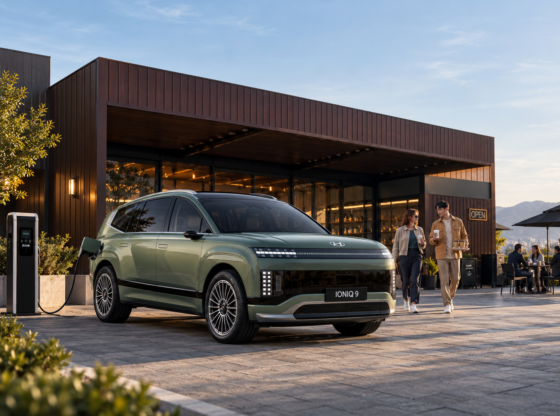

Large electric SUVs have reached an interesting point in their development. The first generation of three-row EVs often seemed like technological demonstrations: enormous batteries, futuristic interiors and impressive acceleration, but also compromises that became obvious once the novelty wore off.
The 2026 Hyundai IONIQ 9 takes a more mature approach. It is large, powerful and unmistakably electric, but its real ambition is surprisingly ordinary. Hyundai wants it to function as a family vehicle that can handle school runs, long highway journeys, luggage, passengers and daily errands without constantly reminding its occupants that they have chosen an EV.
After extended road testing, that approach turns out to be one of the IONIQ 9’s greatest strengths. The SUV combines a 110-kWh battery with up to 335 miles of EPA-rated range, three rows of seating and an 800-volt charging system capable of taking the battery from 10 to 80 percent in around 24 minutes at a suitable 350-kW charger. Prices start at $58,955 in the U.S., before destination charges.
The result is not a flawless electric SUV, but it is one of the more convincing examples of how an EV can become a genuinely practical family vehicle.
A Big EV That Understands What Families Need
The first thing that becomes apparent inside the IONIQ 9 is its size.
This is not a compact crossover with an occasional third row squeezed into the rear. The cabin was designed from the beginning around three rows, and the available six- and seven-seat configurations give passengers substantially more room than many smaller SUVs attempting the same trick.
Independent road testing has found that even adults can use the third row comfortably, which is an important distinction in a segment where the rearmost seats are often best reserved for children. The flat EV floor also contributes to the sense of space, while the cabin’s lounge-like design makes the vehicle feel closer to a large people mover than a traditional SUV.
That practicality becomes even more convincing on longer journeys. The IONIQ 9 provides a substantial amount of room for passengers and luggage without requiring the driver to constantly make compromises between seating capacity and everyday usability.
It is one of those vehicles whose dimensions make more sense once you spend time inside it.
The Driving Experience Is More Relaxed Than Sporty
The IONIQ 9 is not trying to be a performance SUV first.
Even the more powerful versions are better understood as fast, comfortable family vehicles than as electric sports cars. The dual-motor all-wheel-drive Performance version produces 422 horsepower and can accelerate to 60 mph in less than five seconds, but the car’s natural character is considerably calmer.
That is a good thing.
The suspension is tuned primarily for comfort, and the SUV feels composed on highways and smooth roads. Its electric powertrain delivers the immediate response expected from an EV without making every acceleration feel like an event.
Road tests have repeatedly highlighted the vehicle’s quietness and stability. MotorTrend described the IONIQ 9 as remarkably composed for its size, while other long-term testing has praised its smooth powertrain, comfortable ride and overall ease of driving.
There is a clear sense that Hyundai has resisted the temptation to make the IONIQ 9 unnecessarily aggressive.
For a vehicle designed to carry six or seven people, that is exactly the right priority.
The 110-kWh Battery Makes Long Trips Easier
Range is one of the IONIQ 9’s strongest arguments.
Depending on configuration, the SUV offers between 311 and 335 miles of EPA-rated range. The rear-wheel-drive version with the most efficient setup reaches the highest figure, while the more powerful all-wheel-drive models sacrifice some range in exchange for additional performance.
That distinction is important because it gives buyers a meaningful choice rather than forcing every version of the car into the same specification.
The 110-kWh battery is large, but the IONIQ 9 needs that capacity because this is a substantial vehicle. Large electric SUVs naturally consume more energy than compact hatchbacks, and aerodynamic efficiency can only compensate for some of the additional weight and frontal area.
Interestingly, that is also one of the weaknesses identified by reviewers. Auto Express found the IONIQ 9 less efficient than some smaller electric vehicles, noting that its considerable size and weight inevitably affect energy consumption.
The trade-off is straightforward: you are carrying a large battery because you are also carrying a large vehicle.
For families that actually need three rows, that may be an acceptable compromise.
Charging Is One of Its Biggest Advantages
If range makes the IONIQ 9 suitable for long-distance driving, charging technology makes those journeys significantly easier.
The SUV uses Hyundai Motor Group’s 800-volt E-GMP architecture, allowing a 10-to-80-percent charge in roughly 24 minutes when connected to an appropriate 350-kW DC fast charger.
That is fast enough to change how charging fits into a road trip.
A 20-to-25-minute stop can overlap naturally with the kind of break a family might already want to take. Instead of planning a journey around a long charging session, drivers can increasingly treat charging as part of the normal rhythm of the trip.
The technology also demonstrates why peak charging power should not be viewed in isolation. The real advantage comes from the combination of a large battery, high charging capability and an efficient charging curve.
The IONIQ 9 does not eliminate the need to stop. It simply makes the stop much less disruptive.
Inside, the IONIQ 9 Feels More Premium Than Its Badge Suggests
The cabin is another area where Hyundai has made a strong impression.
The dashboard is modern without becoming excessively futuristic, and the overall atmosphere is closer to a premium lounge than a conventional family SUV. Materials, seating comfort and available equipment give the upper versions a convincing upscale character.
The seats are particularly important because the IONIQ 9 is designed for long-distance use. A vehicle can have impressive battery specifications and still be unpleasant after several hours behind the wheel if its seating position or ride quality is poorly judged.
Testing suggests Hyundai got much of this balance right. Electrek’s extended drive praised the seating across all three rows, while Consumer Reports described the interior as nicely appointed and the vehicle as smooth, quiet and easy to live with.
There are some less successful details. The touch-sensitive climate-control panel has been criticized for being less intuitive than conventional physical controls, and some styling decisions inside and out may appeal more to technology enthusiasts than to drivers who prefer simplicity.
Still, these are relatively minor problems in a cabin that otherwise succeeds at making a large electric vehicle feel approachable.
The Software Is Good, But Not Class-Leading
Modern EVs are increasingly judged as much by their software as by their motors and batteries.
The IONIQ 9 is competent in this area, but it does not completely eliminate the feeling that Hyundai’s hardware is ahead of its software.
Independent testing has identified several small frustrations. The navigation system does not automatically handle charging-stop planning as elegantly as the best EV systems, while the companion smartphone application can feel slower than expected. One-pedal driving settings also reset in certain situations, which can become irritating for drivers who prefer a consistent configuration.
These are not failures that make the car difficult to use. They are examples of the gap between a very strong physical product and software that is still catching up with the expectations created by the newest generation of connected vehicles.
The underlying vehicle is sophisticated enough that these details stand out precisely because the rest of the package works so well.
The IONIQ 9 Is Better at Being Normal Than Being Futuristic
Perhaps the most interesting thing about the IONIQ 9 is that it does not constantly demand attention.
It looks futuristic, but it does not require the driver to learn an entirely new way of interacting with a vehicle. The controls are generally familiar, the cabin is practical, visibility is acceptable despite the aerodynamic shape, and the driving experience is predictable.
Consumer Reports made a similar observation after extensive testing, describing one of the IONIQ 9’s greatest strengths as its sense of normality. The SUV feels like a conventional family vehicle that happens to use an electric powertrain rather than a science project placed on four wheels.
That may sound like faint praise, but for electric vehicles it is actually a significant achievement.
The easier an EV becomes to understand and operate, the less important its electric identity becomes in everyday life.
There Is Still a Price to Pay for Going Electric
The IONIQ 9 starts at $58,955 in the U.S., while higher specifications can move toward the upper-$70,000 range before destination charges.
That puts it firmly above Hyundai’s conventional family SUVs.
The comparison becomes especially interesting because buyers can now choose between a large electric SUV and increasingly sophisticated hybrid alternatives. A family that does not need the quietness, instant torque or charging advantages of an EV may decide that a conventional or hybrid SUV represents better value.
The IONIQ 9 therefore has to justify its premium through more than environmental credentials.
Fortunately, it has several strong arguments: very good range, exceptionally fast charging, genuine three-row practicality, a comfortable interior and a refined driving experience.
The question is less whether the vehicle is good enough and more whether the buyer’s lifestyle makes its electric advantages worth the additional cost.
Where the IONIQ 9 Falls Short
No serious review of the IONIQ 9 should ignore its compromises.
Its size makes parking and manoeuvring more demanding than with a smaller crossover. Efficiency is respectable for a vehicle of this scale but cannot compete with smaller, lighter EVs. The third row is genuinely usable, but carrying seven people naturally reduces the amount of luggage space available.
Some interior controls are less intuitive than they should be, while the software experience lacks the polish of the industry’s strongest connected-car platforms. Driver-assistance technology is also not considered the absolute benchmark in this segment. MotorTrend, for example, noted that Hyundai’s assistance systems still trail the best competitors in some areas.
None of these weaknesses fundamentally undermines the vehicle.
They simply establish where the IONIQ 9 sits in the market. It is a highly accomplished electric family SUV rather than a perfect demonstration of every technology currently available.
Verdict: One of the Most Complete Large EVs
The 2026 Hyundai IONIQ 9 succeeds because it understands that a family EV has to do much more than accelerate quickly.
It needs to provide genuine space, comfortable seating, useful luggage capacity, predictable range and charging that does not turn every long journey into an expedition. The IONIQ 9 delivers on most of those requirements, and its 110-kWh battery, up to 335 miles of EPA range and 800-volt charging architecture give it a particularly strong foundation for long-distance use.
Its imperfections are mostly visible at the edges of the experience: software could be smarter, some controls could be more intuitive and the sheer size of the vehicle inevitably affects efficiency.
But the bigger picture is impressive.
The IONIQ 9 demonstrates that a large three-row EV no longer needs to feel like an experiment. It can function as a comfortable, quiet and capable family vehicle while retaining the advantages that make electric propulsion attractive in the first place.
For drivers who genuinely need three rows and regularly travel long distances, that combination makes the IONIQ 9 one of the more convincing electric SUVs available in 2026.