
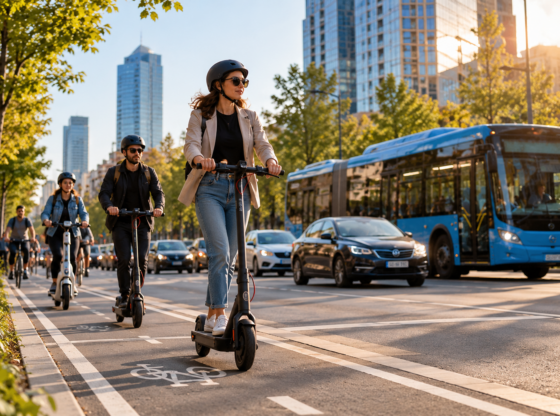

The future of sustainable mobility is often presented through images of electric cars, charging stations and increasingly sophisticated batteries. Yet some of the most important changes in transportation are happening with vehicles that are much smaller.
Electric bicycles, scooters, motorcycles, mopeds and three-wheelers are becoming an increasingly important part of the global shift away from conventional engines. They consume far less energy than passenger cars, require considerably less road and parking space, and can make short urban journeys faster without requiring a large vehicle.
The scale of this transition is already substantial. Global sales of electric two- and three-wheelers reached around 11 million units in 2025, an increase of almost 15% from the previous year. About 10% of the global two- and three-wheeler fleet is now electric, according to the International Energy Agency.
That makes two-wheelers the most electrified major segment of road transport.
The development is particularly significant because it challenges a common assumption about sustainable mobility: that the central task is to replace every petrol-powered car with an electric car. In many journeys, the more efficient solution may be to use a fundamentally smaller vehicle.
The Smallest EVs Are Already a Global Business
Electric two-wheelers are not a niche product waiting for the automotive industry to discover them.
China, India, Viet Nam and Türkiye are already major markets, and together they accounted for approximately 95% of global electric two- and three-wheeler sales in 2025. The regional differences are considerable, but the overall direction is clear.
In some markets, two-wheelers are already an essential form of everyday transportation. That gives electrification a different starting point from the passenger-car market.
A person who already relies on a scooter or motorcycle does not need to be convinced to change from a car to a two-wheeler. The transition can happen within the same category: an internal-combustion motorcycle becomes an electric one, bringing lower energy use and potentially lower operating costs without requiring a completely different travel routine.
This helps explain why electric two-wheelers have achieved such a high level of adoption in parts of Asia.
The technology also fits their physical characteristics particularly well. A small vehicle needs a much smaller battery than a car, which reduces both weight and the amount of expensive battery material required.
Why Size Matters More Than It Seems
The environmental advantage of a smaller electric vehicle is not simply that it has no exhaust pipe.
It also uses less energy to move.
A large electric SUV may be dramatically cleaner in operation than a comparable petrol vehicle, but it still needs a substantial battery and significant amounts of electricity to move its weight. A lightweight electric scooter or bicycle can cover the same short urban distance using a fraction of that energy.
The difference becomes important when multiplied across millions of daily journeys.
This is why sustainable mobility planners are increasingly looking beyond the passenger car. A transportation system that encourages people to choose the smallest practical vehicle for each journey can reduce energy consumption even when all available vehicles are electric.
The principle is simple: electrification improves the powertrain, while vehicle downsizing improves the overall efficiency of the journey.
The two strategies can work together.
Electric Two-Wheelers Are Particularly Suited to Cities
Urban transportation creates a specific set of problems that small electric vehicles can address surprisingly well.
Traffic congestion is one. Parking is another.
A scooter or bicycle requires much less space than a car both while travelling and when parked. In dense areas, that difference can become more important than the difference between two battery chemistries or charging speeds.
Smaller vehicles can also make short trips more flexible. A journey of several kilometres may be too far to walk comfortably but unnecessarily inefficient by car. An electric bicycle or scooter occupies the middle ground, providing motor assistance without the physical and spatial requirements of a full-size vehicle.
This is particularly relevant as cities reconsider how much public space should be dedicated to moving and storing private cars.
The European Union’s updated 2026 Sustainable Urban Mobility Planning guidelines explicitly strengthen the role of cycling within integrated urban transport planning. The new guidance is intended to help cities create transport systems that are more sustainable, inclusive and efficient, while cycling is treated as part of the wider mobility network rather than a separate recreational activity.
That change in planning philosophy could become increasingly important as electric bicycles become more capable.
The E-Bike Is More Than a Faster Bicycle
Electric bicycles occupy an especially interesting position in the mobility system.
They retain many of the advantages of conventional bicycles, including their compact dimensions and low energy consumption, but electric assistance changes the practical distance that people are willing to travel.
A longer commute becomes more manageable. Hills become less intimidating. Carrying groceries becomes easier. Riders can arrive at work without the same level of physical exertion that might discourage them from cycling every day.
That makes the electric bicycle more than a recreational product.
For some people, it becomes a genuine alternative to a car for everyday journeys.
The sustainability benefit becomes strongest when the e-bike replaces a car journey rather than a conventional bicycle journey. If someone who previously walked simply buys an electric bicycle, the environmental gain is relatively small. If the e-bike replaces a daily car commute, the potential reduction in energy use and emissions is much greater.
This is why infrastructure matters so much.
Infrastructure Can Decide Whether the Idea Works
A city cannot simply sell thousands of electric bicycles and expect a sustainable mobility revolution to happen automatically.
People need safe places to ride them.
Protected cycle routes, secure parking, charging facilities and convenient connections to public transport can make lightweight electric vehicles a practical part of everyday transportation. Without that infrastructure, riders may be forced to compete with much larger and faster vehicles, limiting adoption.
The European Commission’s 2026 urban-mobility framework increasingly reflects this integrated approach. Its sustainable mobility policies emphasize public transport and active mobility while also addressing congestion, accessibility, road safety and urban logistics.
That is important because the success of an e-bike is not determined solely by its motor or battery.
It depends on the street outside the user’s home.
A technically excellent electric bicycle is of limited value if the safest available route is still a congested road designed primarily for cars.
Electric Scooters Are Becoming Part of the Same Transition
Electric scooters and small motorcycles occupy another part of the two-wheeler market.
Their advantage is that they can provide more speed and carrying capacity than a conventional bicycle while remaining significantly smaller and more energy-efficient than a passenger car.
The IEA’s latest data show how rapidly the category is expanding. Electric two- and three-wheeler sales reached about 11 million globally in 2025, with electric two-wheelers accounting for almost eight times as many sales as electric three-wheelers.
The market is also developing new business models.
Financing programmes, daily-payment schemes and ride-to-own models are helping some customers access electric two-wheelers without paying the full purchase price upfront. The IEA notes that such financing innovations have supported adoption in emerging markets, while electric two-wheelers have also become increasingly important for commercial fleets and delivery services.
That last point could prove particularly significant.
A delivery rider covers much more distance each day than the average private user. Lower energy and maintenance costs can therefore have a direct effect on the economics of the business.
Three-Wheelers Reveal Another Side of Electrification
Electric three-wheelers are less visible in global automotive coverage, but they are becoming an important transportation technology in their own right.
They are used for passenger transport, deliveries and small-scale commercial activity, particularly in markets where conventional three-wheelers already play a major role.
In 2025, electric three-wheelers represented more than 25% of global three-wheeler sales, according to the IEA. In some markets, the share is dramatically higher.
Their appeal is partly economic.
A three-wheeler can carry passengers or cargo while requiring substantially less energy than a van or car. Electrification can therefore reduce the operating cost of commercial transportation without requiring businesses to move to a much larger vehicle.
This is an important reminder that sustainable mobility is not exclusively a consumer trend.
Commercial transport can be one of the strongest drivers of electrification when the financial case is clear.
Battery Technology Looks Different at This Scale
The batteries used in electric two-wheelers do not need to achieve the same capacity as those installed in passenger cars.
That changes the engineering equation.
A smaller battery can be cheaper and easier to replace, while a lightweight vehicle does not require enormous amounts of stored energy. In some applications, removable batteries can also make charging more convenient because the user does not need access to a dedicated charging station.
This can be particularly useful in dense urban environments where riders may live in apartments or buildings without private parking.
The smaller scale also creates opportunities for battery-swapping systems. Instead of waiting for a battery to recharge, a rider can exchange a depleted pack for a charged one at a compatible station.
Whether that model becomes widespread will depend on standardization and business economics, but it demonstrates one of the advantages of designing mobility around smaller vehicles: charging infrastructure does not necessarily have to resemble the large public charging stations being built for cars.
The Biggest Opportunity May Be Commercial Mobility
Private commuters are only part of the story.
Electric two-wheelers are particularly attractive for delivery services, courier operations and other businesses that depend on frequent short-distance travel.
A delivery vehicle may spend most of the day moving through congested streets, stopping repeatedly and covering relatively predictable distances. These are exactly the conditions in which a lightweight electric vehicle can have a strong operational advantage.
The financial logic can be more powerful than environmental messaging.
If an electric scooter uses less energy, requires less maintenance and avoids some of the costs associated with conventional fuel, the business case can remain attractive even without generous subsidies.
That is one reason financing and fleet programmes have become increasingly important to the growth of electric two-wheelers. The IEA highlights business-model innovation as one of the factors supporting adoption in several major markets.
In other words, sustainable mobility does not always have to be sold as an environmental sacrifice. In many cases, it can simply be the cheaper and more efficient way to operate.
Europe Shows Why Policy Matters
The European market illustrates the difficulty of translating technological potential into widespread adoption.
Electric two-wheelers accounted for less than 2% of global electric two-wheeler sales in 2025, with around 160,000 units sold in Europe. Sales actually declined by almost 5% compared with 2024, while the regional electric sales share has remained around 6% in recent years.
That contrast with markets such as China, India and Viet Nam is revealing.
Europe has strong cycling infrastructure in some areas and growing interest in micromobility, but adoption of motorized two-wheelers is structurally different. Consumer preferences, regulations, infrastructure and policy support all influence the result.
The lesson is that there is no universal formula for sustainable mobility.
A technology that expands rapidly in one region may struggle in another because the transportation culture and infrastructure are different.
That makes local mobility planning important even within a global transition.
The Future May Be Smaller Than Expected
The most interesting implication of electric two-wheelers is that sustainable mobility does not necessarily require increasingly sophisticated vehicles.
In fact, the opposite may sometimes be true.
The transportation industry has spent years making vehicles larger, faster and more technologically complex. Electric propulsion creates an opportunity to rethink that direction. If a lightweight vehicle can satisfy the needs of a particular journey, using a larger vehicle may simply be unnecessary.
That does not mean cars are going away.
Families will still need larger vehicles. Long-distance travel will still require substantial range and luggage capacity. People with mobility limitations or demanding work requirements may depend on cars.
But a transportation system does not have to use the same type of vehicle for every journey.
A city where some trips happen by train, others by bus, others by bicycle and others by small electric scooters can move people with less energy and less congestion than a city where almost every journey requires a private car.
A Different Way to Measure Mobility
The growth of electric two-wheelers suggests that sustainable mobility should ultimately be measured by more than the number of electric vehicles on the road.
It should also consider how much energy each journey requires, how much space vehicles consume, how many people they carry and whether different forms of transport can work together.
That is increasingly reflected in policy. In July 2026, the European Commission introduced a common set of urban mobility indicators covering sustainability, safety and accessibility, with the first data submissions from member states due by the end of 2027.
Better measurement can change the way cities make investment decisions.
Instead of asking only how many electric cars have been registered, planners can examine whether people have realistic alternatives to driving, whether cycling infrastructure is safe, whether public transport connects efficiently and whether the transportation system is accessible to different groups of residents.
That is a much broader definition of sustainability.
The Small Vehicle Could Have the Big Impact
Electric cars will remain one of the central technologies of the transportation transition, but the rapid growth of electric two- and three-wheelers shows that the future of mobility may be considerably smaller and more diverse than the conventional automotive industry suggests.
Around 11 million electric two- and three-wheelers were sold globally in 2025, and their adoption continues to expand across major markets.
Their importance comes from a simple combination of characteristics: low energy consumption, compact dimensions, relatively simple charging requirements and the ability to cover the distances that make up a large share of everyday urban travel.
The next challenge is making cities ready for them.
That means safer cycling infrastructure, better parking, charging solutions, integration with public transport and policies that recognize small electric vehicles as a legitimate part of the mobility system.
The sustainable transportation revolution may therefore not be defined only by the arrival of better electric cars.
It may also be defined by people choosing not to use a car when they do not need one.
That is a much more fundamental change. Instead of replacing every large vehicle with an electric equivalent, cities can begin to build transportation systems in which the vehicle itself is matched more closely to the journey. When that happens, electrification becomes only one part of a much larger transformation — one in which mobility becomes lighter, more flexible and considerably more efficient.