

The electric-car market has become crowded enough that simply offering a decent range and a large touchscreen is no longer enough to make a new model interesting. Manufacturers now have to find a more convincing balance between efficiency, practicality, design, driving comfort and price.
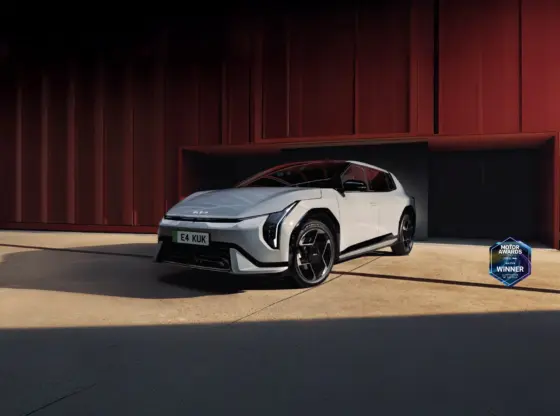
The 2026 Kia EV4 is an interesting response to that challenge. It is not an SUV in the traditional sense, even though it shares much of its technology with Kia’s expanding electric lineup. Instead, Kia has created a lower-slung C-segment electric car with two distinct body styles: a conventional hatchback and a longer fastback.
That decision immediately gives the EV4 a different character from many of the electric crossovers currently dominating the market.
Kia positions the model as a practical everyday EV with a maximum WLTP range of up to 630 kilometres in Europe, while UK pricing starts at £30,995. Depending on specification and market, the car can be equipped with either a 58.3 kWh or 81.4 kWh battery.
On paper, the numbers are competitive. The more important question is whether the EV4 feels as convincing once those specifications are translated into everyday driving.
The EV4 Takes a Different Route From the SUV Crowd
The first thing that separates the EV4 from many modern electric cars is its shape.
The market has developed a strong preference for crossovers, but Kia has deliberately gone lower with the EV4. The result is a car that sits somewhere between a traditional hatchback and a fastback sedan, with a long body and a relatively low roofline.
That design gives the EV4 a more aerodynamic appearance, but it also serves a practical purpose. Kia has been able to create a vehicle with a relatively long wheelbase and a spacious cabin without turning it into another tall crossover.
The fastback version takes the concept even further. Its extended rear section gives the car a more distinctive silhouette and provides additional luggage capacity, while the hatchback remains the more compact and conventional choice.
For buyers who have become tired of the endless stream of electric SUVs, that alone makes the EV4 refreshing.
It looks like a car designed around aerodynamic efficiency rather than simply following the current crossover fashion.
Two Batteries, Two Different Personalities
The EV4 is available with two main battery configurations, and the difference between them has a meaningful effect on the car’s role.
The smaller battery has a capacity of 58.3 kWh, while the long-range version uses an 81.4 kWh pack. Kia’s European specifications quote up to 630 km of WLTP range for the most efficient configuration.
The smaller battery makes more sense for drivers whose daily journeys are relatively predictable. It reduces the amount of battery that has to be carried around and allows the EV4 to be positioned at a more accessible price point.
The larger pack, meanwhile, turns the car into a much more serious long-distance vehicle.
That distinction is increasingly important in the EV market. Buyers are beginning to understand that the biggest battery is not automatically the best choice. A driver covering relatively short distances may benefit more from a lighter, cheaper car, while someone who regularly travels between cities will appreciate the additional range.
The EV4 gives customers that choice without forcing them into a completely different model.
Range Is One of Its Strongest Arguments
The long-range EV4 can officially travel up to 630 km on a single charge in European testing, putting it among the more impressive range figures available in its class.
That figure should always be treated as a laboratory benchmark rather than a promise of real-world driving. Weather, speed, temperature, wheel size and use of heating or air conditioning can all affect consumption.
Nevertheless, the underlying efficiency of the EV4 is important.
A relatively low vehicle profile gives Kia an aerodynamic advantage over many taller electric crossovers. That becomes particularly useful on highways, where aerodynamic drag has a much greater influence on energy consumption.
The EV4 therefore demonstrates why range cannot be separated from vehicle design. A large battery can provide impressive numbers, but a more efficient body can achieve a similar result without requiring the same amount of stored energy.
For an electric car intended to serve as an everyday family vehicle, that is a sensible engineering philosophy.
Charging Is Fast Enough for Real Road Trips
Kia has also paid attention to charging performance.
The European EV4 can recharge from 10 to 80 percent in approximately 29 to 31 minutes under suitable conditions, according to Kia’s current specifications.
That is not the fastest charging time in the electric-car market, but it is quick enough to make longer journeys practical.
The difference becomes particularly noticeable when the car is used for highway travel. A charging stop of roughly half an hour can fit naturally into a road trip, especially when passengers need a break.
The experience also benefits from the larger battery’s range. Drivers do not necessarily need to charge every time they stop. The ability to combine a substantial driving range with reasonably fast charging gives the EV4 flexibility that smaller-battery EVs cannot always match.
For everyday use, the car can simply be charged at home. For longer journeys, the combination of range and DC charging provides a useful safety net.
Behind the Wheel, the EV4 Is More Interesting Than Its Numbers Suggest
The EV4 is not intended to be a sports car, but its low-slung body gives it a different feel from many electric SUVs.
The driving position is relatively conventional, and the car feels more connected to the road than a tall crossover. That does not mean it is aggressively tuned. Kia has clearly prioritized comfort and stability for everyday use, while still giving the EV4 enough response to make urban driving and faster roads feel engaging.
The current range includes a 150 kW motor in standard configurations, with front-wheel drive. Kia’s Korean specification lists 150 kW of maximum output alongside the 58.3 kWh battery.
The result is enough performance for normal driving without turning efficiency into an afterthought.
That balance is important. Electric cars can produce impressive acceleration almost effortlessly, but excessive power can add weight, reduce efficiency and increase the price. The EV4 seems more interested in being a well-rounded car than in winning acceleration comparisons.
The Interior Is Designed Around Everyday Use
Inside, Kia has continued the design language used across its newer electric models.
The dashboard is dominated by a wide digital display arrangement, while the cabin uses a mixture of physical controls and touch interfaces. The current EV4 specification includes a 12.3-inch navigation display, a digital instrument cluster and a separate climate-control screen.
That combination is useful because the driver does not have to perform every function through one enormous central touchscreen.
The interior also includes features such as relaxation seats, connected services and Kia’s AI assistant in certain markets. The company is clearly trying to make the cabin feel like a connected digital environment without abandoning the basic ergonomics of a conventional car.
There is a broader trend here. Modern EV interiors increasingly resemble living spaces, but the most successful designs still need to work while the driver is moving.
The EV4 generally keeps that distinction in mind.
The Fastback Is More Than a Styling Exercise
The availability of two body styles makes the EV4 particularly interesting.
The hatchback is the obvious choice for buyers who want a compact and practical electric car. Its shape is easier to manoeuvre in urban environments and gives the model a familiar everyday character.
The fastback, however, makes a stronger visual statement. Its longer profile gives the EV4 a more distinctive presence while maintaining the same basic electric-car architecture.
Kia has effectively created two interpretations of the same vehicle. One emphasizes practicality and compact dimensions; the other puts more emphasis on style and long-distance character.
That approach may become more common as electric platforms mature. Once the underlying architecture is flexible enough, manufacturers can create different body styles without developing an entirely new vehicle from scratch.
Price Is Where the EV4 Becomes Particularly Interesting
The EV4 starts at £30,995 in the UK, while higher specifications move considerably higher. Kia’s UK range currently extends to the GT-Line S, with fastback versions positioned above the hatchback.
That makes the entry model important because it places a substantial electric car below the price of many premium EVs.
Of course, the cheapest version does not deliver the maximum 630-km range. That figure belongs to a more expensive long-range configuration, and buyers have to decide whether the additional battery capacity is worth paying for.
That is actually a healthy situation for the market.
Rather than presenting one expensive specification as the only sensible choice, Kia gives customers the opportunity to match the car to their budget and driving habits.
The same philosophy can be seen in the South Korean market, where the 2026 EV4 starts from 40.42 million won after applicable tax benefits in the Air Standard configuration. The standard version uses the 58.3 kWh battery.
Prices naturally vary between markets because of taxation, equipment and incentives, but the basic strategy remains consistent: offer a relatively accessible entry point and allow buyers to move toward longer range and higher equipment.
Where the EV4 Still Has Room to Improve
The EV4 is a strong all-rounder, but it is not without compromises.
The most obvious is that the lower body means it does not offer the same elevated driving position as an SUV. For some buyers, particularly those accustomed to crossovers, that may be a disadvantage rather than an advantage.
The other issue is complexity of choice. With two body styles, multiple batteries and several trim levels, the range can become difficult to understand at first. The best version depends heavily on whether the buyer prioritizes price, range, equipment or appearance.
There is also the unavoidable difference between official range and real-world range. A claimed 630 km is impressive, but highway speeds and cold conditions can significantly reduce the distance an EV can cover.
These are not unique EV4 problems. They are simply part of the reality of buying an electric car in 2026.
Verdict: A Sensible Alternative to the Electric Crossover
The Kia EV4 is interesting precisely because it does not try to be extraordinary in every category.
It is not the fastest EV. It is not the largest. It does not offer the biggest battery in its segment, and its charging speed is not a record-setter.
Instead, Kia has created a car that tries to get many important things right at the same time.
It offers a useful entry price, a long-range battery option, up to 630 km of WLTP range, reasonably quick DC charging and a choice between hatchback and fastback body styles.
That combination gives the EV4 a clear identity.
In a market increasingly filled with tall electric crossovers, it offers an alternative for drivers who want the efficiency and quietness of an EV without automatically moving into an SUV. Its long-range version can handle serious highway travel, while the smaller battery keeps the entry point more accessible.
The 2026 Kia EV4 ultimately succeeds because it feels like a carefully considered car rather than a collection of impressive specifications. It takes the technology that has become familiar in larger and more expensive EVs and packages it into a lower, more conventional vehicle.
For buyers looking for an electric car that can fit naturally into everyday life without demanding an SUV-sized footprint, the EV4 deserves a place near the top of the shortlist.