
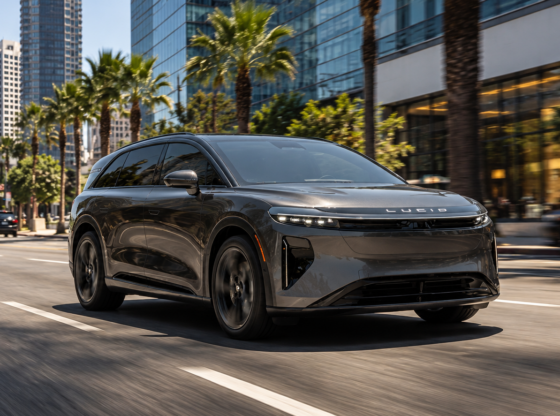

The Lucid Gravity arrives with the kind of specification sheet that makes an electric SUV look almost unreal. Up to 450 miles of EPA-estimated range, as much as 828 horsepower, seating for up to seven people and charging capability of up to 400 kW put it firmly at the ambitious end of the EV market. Yet the most interesting thing about the Gravity is not any individual number. It is the way Lucid has tried to combine performance, efficiency and family practicality in one large vehicle.
That combination becomes much more meaningful after spending time behind the wheel.
The 2026 Gravity Grand Touring is a serious luxury vehicle, with a 123-kWh battery, dual electric motors and all-wheel drive. Lucid quotes 450 miles of EPA range for the most efficient two-row configuration, while the three-row version delivers less depending on wheel size and seating configuration. The company also claims that a suitable high-power charger can add 200 miles of range in less than 11 minutes.
Independent testing suggests that much of this impressive specification translates into genuine road-going ability. But it also reveals where the Gravity still feels like a product from a relatively young EV manufacturer.
A Large SUV That Does Not Drive Like One
The Gravity’s physical dimensions initially suggest a conventional full-size SUV. It is almost 198 inches long, can accommodate up to seven occupants and has enough cargo space to serve as a genuine family vehicle.
Once it starts moving, however, the impression changes.
The Gravity has a relatively low driving position for a vehicle of this size, and its aerodynamic body avoids the upright, boxy proportions associated with many large SUVs. Lucid quotes a drag coefficient of just 0.24, an unusually low figure for such a substantial vehicle. That aerodynamic efficiency is one of the main reasons the company can extract so much range from its battery.
The effect on the road is equally noticeable. Independent testing has found that the Gravity feels considerably smaller and more agile than its dimensions suggest. Consumer Reports praised its sharp handling and noted that the SUV’s weight is surprisingly well concealed when the road becomes more interesting.
That is not something every large electric SUV can claim.
828 Horsepower Is Almost Excessive
The Grand Touring version produces 828 horsepower and 909 lb-ft of torque. Those numbers would be remarkable in a sports car, let alone a three-row family SUV.
Acceleration is consequently extreme. Lucid quotes 0–60 mph in 3.4 seconds, while independent testing has recorded times in the same general territory. MotorTrend achieved 3.2 seconds in its testing, while Consumer Reports recorded 3.6 seconds.
What makes the experience unusual is the absence of drama.
The Gravity does not necessarily feel like a car desperately trying to prove how fast it is. Power arrives smoothly and almost effortlessly. There is no engine noise building toward a dramatic shift point, and the sheer amount of available torque means that overtaking requires very little planning.
For a family vehicle, that effortless character is more useful than spectacular acceleration for its own sake.
The performance becomes particularly valuable on highways. A heavily loaded SUV can sometimes feel reluctant when passing at speed, but the Gravity has more than enough reserve power to make those situations almost trivial.
The Range Story Is Even More Impressive
Performance is not the Gravity’s most important technical achievement.
Its range is.
Lucid advertises up to 450 miles of EPA range for the Grand Touring in a two-row configuration with smaller wheels. The figure drops when larger wheels are fitted or when the third row is used. The official specification lists 437 miles for a three-row configuration with the smaller wheel setup, while larger wheels can reduce the number substantially.
That distinction matters because it shows how sensitive a large EV can be to configuration.
The same basic vehicle can have very different efficiency depending on wheel size and seating arrangement. Buyers who want the maximum possible range therefore need to pay attention to equipment choices rather than assuming that every Gravity will deliver the headline figure.
Real-world testing remains encouraging.
In one extended test, the Gravity Touring covered 320 miles on a full charge across suburban and highway driving, coming reasonably close to its EPA estimate. The tester also recorded an average of 3.3 miles per kWh in mixed driving and 3.8 miles per kWh during steady freeway travel.
That is an important result because it demonstrates that Lucid’s efficiency claims are not limited to laboratory conditions.
Highway Efficiency Is Where the Gravity Makes Its Case
Large electric vehicles usually face an unavoidable problem: size and weight consume energy.
The Gravity partially solves this through aerodynamics.
At highway speeds, air resistance becomes one of the biggest forces working against an EV. Lucid has therefore designed the body around reducing drag rather than simply accepting the inefficiency associated with a large SUV.
The results are visible in independent tests. MotorTrend recorded 335 miles of highway range at a steady 70 mph in its Grand Touring test vehicle, while Consumer Reports achieved 361 miles in its own 70-mph range test.
Those figures are considerably more useful than the headline 450-mile number when thinking about long-distance travel.
They suggest that the Gravity is not simply a city vehicle with a large theoretical range. It is genuinely capable of covering substantial highway distances between charging stops.
That distinction could become one of the vehicle’s strongest selling points.
Charging Is One of Lucid’s Biggest Advantages
The Gravity’s charging system is almost as impressive as its range.
The vehicle uses a 926-volt electrical architecture and can accept up to 400 kW on compatible 1,000-volt charging equipment. Lucid also developed a system that allows the vehicle to work effectively with 500-volt charging infrastructure, where it can boost the incoming voltage through its powertrain hardware.
The company claims that a properly equipped Gravity can add 200 miles of range in less than 11 minutes.
Real-world results are naturally more complicated because charging speed depends on the charger, battery temperature, state of charge and other conditions. Car and Driver recorded approximately 150 miles of additional range in 20 minutes using a 350-kW charger.
Even so, the charging performance is excellent.
The bigger advantage is that the Gravity combines fast charging with unusually high efficiency. A fast-charging vehicle is useful, but a fast-charging vehicle that can also travel a long distance on each charge is much more valuable for frequent road trips.
That combination is where Lucid has established one of its clearest technical advantages.
The Interior Makes Clever Use of the Space
The Gravity’s interior is less spectacular than its performance figures, but that is not necessarily a criticism.
Lucid has focused on creating usable space rather than simply filling the cabin with visual technology. The five-seat version offers up to 120 cubic feet of total interior volume, and the optional third row can accommodate two additional passengers.
The packaging is particularly effective because the electric architecture allows Lucid to push the cabin forward.
Rear passengers benefit from generous legroom, while access to the third row is easier than the exterior dimensions might suggest. WIRED found that even a 6-foot-6-inch passenger could get into the third row and sit with reasonable comfort.
Cargo flexibility is another strength.
With the third row folded, the Gravity becomes a very substantial luggage carrier, while the front trunk adds another useful storage area. The Drive measured 21.3 cubic feet behind the third row, 56.2 cubic feet behind the second and 111.9 cubic feet behind the first.
This is where the vehicle begins to make a convincing case as a family SUV rather than simply a high-performance luxury EV.
The Cabin Technology Is Impressive, but Not Perfect
Lucid has equipped the Gravity with a large 34-inch curved 6K OLED display and its UX 3.0 software platform. An available augmented-reality head-up display adds another layer of information without requiring the driver to constantly look toward the main screen.
The presentation is undeniably modern.
However, this is also one of the areas where the Gravity’s weaknesses become apparent.
Consumer Reports has identified several software glitches and criticized the vehicle’s reliance on large touchscreens. Other testers have also reported software issues that can interfere with an otherwise polished driving experience. Electrek, after more than 547 miles of testing, described the vehicle as highly impressive overall but noted software problems that Lucid still needs to address.
This is an important distinction.
The Gravity’s hardware feels mature. Its powertrain, suspension, battery efficiency and charging system are among the strongest aspects of the vehicle. The software experience is less consistently finished.
For a company positioning itself against established luxury brands, that gap matters.
Ride Comfort and Handling Are Unusually Well Balanced
A large SUV does not normally invite comparisons with sports cars, but the Gravity makes that comparison surprisingly easy.
Its steering is responsive, body control is strong and the suspension keeps the vehicle composed without turning the ride excessively harsh. Consumer Reports found the handling unusually sharp for a three-row SUV, while The Drive praised the combination of family practicality and dynamic ability.
The vehicle’s size never completely disappears, of course.
You still know that you are driving a large SUV when manoeuvring through tight spaces. But at speed, the Gravity becomes remarkably settled, and the low aerodynamic profile contributes to a sense of stability.
That balance is one of the vehicle’s most successful characteristics.
Lucid has not simply made a large EV fast. It has created one that can carry a family while still being enjoyable to drive.
The Price Changes the Conversation
The Gravity’s biggest challenge may have little to do with its engineering.
The Touring version starts at $79,900, while the Grand Touring begins at $98,900 in Lucid’s current model lineup. The most powerful GT-S reaches $125,900.
That puts the Gravity firmly into the premium segment.
At those prices, buyers are entitled to expect excellent materials, reliable software, refined assistance systems and consistently high build quality. This is where some independent testing raises concerns.
Consumer Reports reported glitches and questioned whether the vehicle was fully finished at launch, while other reviews have praised the underlying engineering but noted that software still needs refinement.
The Gravity therefore represents a somewhat unusual proposition.
Its mechanical and electrical technology can compete with, and in some respects exceed, much more established luxury EVs. Its software maturity and ownership experience still have more to prove.
Which Gravity Makes the Most Sense?
The Grand Touring is the specification that attracts attention because of its 450-mile maximum range and 828-horsepower output.
But the Touring may actually be the more rational choice for many buyers.
It produces 560 horsepower, reaches 60 mph in a claimed four seconds and offers up to 337 miles of EPA range. Independent testing of the Touring found that this was already more than sufficient for normal driving, with one tester covering 320 miles on a full charge.
That is an important reminder that the most expensive EV is not automatically the most useful.
The Touring has enough power to make a very large SUV genuinely quick and enough range to handle substantial road trips. The Grand Touring’s advantages become most valuable to drivers who frequently travel long distances and want the maximum possible range between stops.
For everyone else, the less expensive version may represent the better balance.
Verdict: An Extraordinary EV With One Important Caveat
The Lucid Gravity is one of the most technically impressive electric SUVs available in 2026.
Its combination of efficiency, range, charging speed, interior space and performance is difficult to match. The Grand Touring can travel up to 450 miles on the EPA cycle, charge at up to 400 kW and produce 828 horsepower, while the vehicle remains capable of carrying up to seven people.
More importantly, independent testing confirms that the strengths are not merely theoretical. The Gravity has demonstrated strong highway range, excellent efficiency for its size, rapid charging and unusually good handling for a large three-row SUV.
The reservation is software and overall refinement.
Lucid has built a remarkable electric powertrain and an exceptionally efficient vehicle, but some testers have encountered glitches and questioned whether every part of the ownership experience is as polished as the hardware.
That makes the Gravity an unusual kind of luxury EV. It is already extraordinarily good at the things that are hardest to engineer — efficiency, range, charging and dynamics — while still needing improvement in some of the details that make a premium vehicle feel completely finished.
For drivers willing to pay for its combination of space and electric performance, however, the Gravity is far more than another large EV. It is evidence that a family SUV can be practical enough for everyday life and still deliver the efficiency and driving character of a much smaller vehicle.