
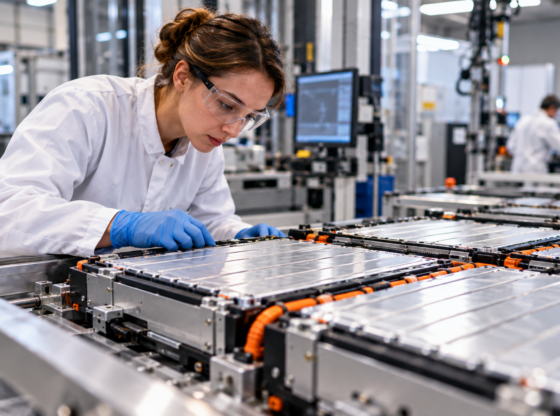

For years, solid-state batteries have been one of the most discussed technologies in the battery industry. They have been linked to longer driving ranges, faster charging and potentially safer electric vehicles, yet their arrival has repeatedly seemed to remain just a few years away.
That situation is beginning to change.
In 2026, solid-state battery development has moved into a more practical phase. Companies are building pilot production lines, testing cells under automotive conditions and working with manufacturers to solve the engineering problems that stand between laboratory prototypes and mass production. The technology is still developing, but it is no longer simply a research project.
The International Energy Agency describes solid-state batteries as a technology that is progressing but still needs to demonstrate its advantages at scale. All-solid-state cells are already being produced in small quantities for testing, while manufacturing remains more complex and expensive than conventional lithium-ion production.
That distinction is important. The next stage of the solid-state battery story will not be decided by whether engineers can build a working cell. They can. The real challenge is whether manufacturers can build millions of those cells with consistent quality and at a price that makes sense for the automotive market.
The Basic Idea Is Surprisingly Simple
A conventional lithium-ion battery contains an electrolyte that allows lithium ions to move between the cathode and anode. In most current batteries, that electrolyte contains a liquid solution.
A solid-state battery replaces that liquid electrolyte with a solid material.
The change sounds straightforward, but it can affect almost every part of the cell’s design. Researchers are exploring different solid electrolytes, electrode materials and manufacturing techniques, with the aim of creating a battery that can store more energy without becoming significantly larger or heavier.
One of the most important possibilities involves the anode. Solid-state designs can potentially use lithium metal instead of the graphite commonly found in conventional lithium-ion cells. Because lithium metal can store a large amount of energy relative to its weight, it offers a path toward higher energy density.
For electric vehicles, that could be valuable.
A lighter battery could help improve efficiency, while a more energy-dense battery could provide greater driving range without requiring a larger pack. Automakers could also use the additional energy density to rethink the proportions and packaging of future vehicles.
These are attractive possibilities, but they remain possibilities until the technology can perform reliably over thousands of charging cycles.
The Laboratory Is No Longer the Main Battleground
One of the biggest changes in 2026 is where the industry’s attention is focused.
A few years ago, much of the discussion around solid-state batteries centred on materials science. Researchers were trying to identify electrolytes that could conduct ions efficiently while remaining stable and manufacturable.
Those questions have not disappeared. However, the industry is increasingly focused on what happens after the chemistry works.
TrendForce reported in August 2026 that all-solid-state batteries had entered an engineering-validation phase. Companies in Japan, South Korea and China have moved beyond early laboratory proof-of-concept work, while leading manufacturers are concentrating on manufacturing processes, product consistency and automotive qualification.
That shift is significant because battery manufacturing is extremely demanding.
A laboratory can produce a small number of carefully controlled cells. A factory must produce thousands of cells every day, and each one needs to meet strict performance and safety requirements. Even a small defect rate can become a serious problem when production reaches millions of units.
Solid-state batteries therefore have to prove two things at the same time. The chemistry must work, and the manufacturing process must be repeatable.
Pilot Factories Are Providing the Missing Link
This is why pilot production has become one of the most important developments in the sector.
QuantumScape inaugurated its Eagle pilot line in February 2026. The company describes the facility as a highly automated production system designed to produce cells for customer sampling, testing and technology demonstrations while also helping develop a scalable manufacturing process.
A pilot line is not the same as a mass-production factory. Its purpose is to bridge the gap between laboratory development and industrial manufacturing.
Engineers can use such a facility to identify weaknesses in the production process. They can measure production yields, improve automation and determine how materials behave when manufacturing volumes increase.
This stage may not generate the most dramatic headlines, but it could determine whether solid-state batteries become commercially important.
A breakthrough cell is impressive. A reliable manufacturing process is what turns that cell into a product.
Automakers Are Finally Putting Solid-State Cells Into Vehicles
Another sign of progress is the move toward real-world automotive testing.
In June 2026, Stellantis and Factorial announced that they had integrated Factorial’s FEST solid-state battery cells into a Dodge Charger Daytona development vehicle and started a road-testing programme. The companies said the testing would evaluate performance, safety and reliability under real driving and charging conditions.
This represents a major change in the development process.
A battery on a laboratory bench operates under controlled conditions. A battery in a vehicle has to cope with vibration, acceleration, repeated charging, temperature changes and the demands of a complete electrical system.
It also has to work with the vehicle’s cooling architecture and battery-management software.
That makes vehicle testing an essential step toward commercialization. Engineers can discover problems that would be difficult to identify through cell testing alone, while automakers can begin learning how the new technology affects the design of the entire vehicle.
Factorial and Stellantis had previously reported a cell energy density of 375 Wh/kg and charging from 15% to 90% in 18 minutes in their development work. Those figures are promising, but the current road-testing programme is important because it tests how that technology behaves as part of a real vehicle rather than as an isolated cell.
There Is No Single Solid-State Battery
Another reason the technology can be difficult to understand is that “solid-state battery” describes a broad group of technologies.
Different companies are developing different solid electrolytes and cell architectures. Sulfide-based systems have attracted considerable attention, while oxide and polymer approaches are also being developed.
Each route involves trade-offs.
Some materials offer attractive ion conductivity. Others may provide better chemical stability or easier manufacturing. Some require particular pressure or temperature conditions to maintain reliable contact between the electrolyte and electrodes.
This explains why companies can announce solid-state batteries that look very different from one another.
The industry is still determining which combination of materials and manufacturing techniques can deliver the best balance between performance, durability and cost.
TrendForce says sulfide-based technology has become the leading route during the current small-scale pilot-production stage, while companies continue to develop the materials and manufacturing infrastructure needed to support future commercial volumes.
The winning design may ultimately be the one that is easiest to manufacture rather than the one that produces the highest laboratory specification.
The Battery Pack Is Almost as Important as the Cell
There is another engineering problem that is easy to overlook.
A good solid-state cell still has to become part of a usable battery pack.
Conventional lithium-ion batteries have benefited from decades of experience in pack design, thermal management and battery-control systems. Solid-state cells can require different mechanical conditions, including greater pressure in some architectures.
The IEA notes that integrating all-solid-state cells into EV packs remains complicated and can require stricter mechanical requirements than conventional lithium-ion systems.
This is one reason the transition cannot happen simply by replacing today’s cells with new ones.
The battery pack may need to be redesigned around the characteristics of the new chemistry. Cooling systems, structural components, control software and charging strategies may all have to change.
That adds time and cost to development.
It also explains why partnerships between battery companies and automakers have become so important.
Honda and QuantumScape Show How Collaboration Is Changing
In June 2026, QuantumScape and Honda announced a multi-year joint research agreement focused on advancing QuantumScape’s solid-state battery platform and the manufacturing processes associated with it. Honda had previously conducted a technical evaluation of the technology before moving into the next stage of collaboration.
The agreement illustrates a broader shift in the industry.
Battery developers can create new cell technologies, but automakers understand the requirements of production vehicles. They know how batteries need to behave inside a vehicle and what customers expect from a commercial product.
Working together can therefore reduce the gap between cell development and vehicle integration.
It also gives battery companies a clearer route toward eventual commercialization.
This type of cooperation is likely to become more common as solid-state batteries move further into engineering validation.
Cost May Be the Hardest Problem of All
Performance attracts attention, but cost will determine how widely solid-state batteries are adopted.
The first generations are likely to be expensive because their manufacturing processes are not yet mature. New materials, specialised production equipment and lower production volumes all increase costs.
The IEA expects solid-state batteries to remain concentrated in premium applications for some time. Its current assessment suggests that the technology is unlikely to make a major impact on the mass-market EV segment until the first half of the 2030s.
That may not be a weakness.
Premium vehicles can provide a market in which manufacturers can charge more for higher performance. Those early products can also generate valuable manufacturing experience, allowing companies to improve production methods before attempting to compete in lower-cost segments.
The history of advanced technology suggests that this process can take years.
Early products rarely represent the final form of a technology. They are often stepping stones toward better manufacturing and lower prices.
Conventional Lithium-Ion Batteries Are Still Improving
Solid-state batteries also face an opponent that is becoming harder to beat: modern lithium-ion technology.
Battery manufacturers have spent decades improving lithium-ion cells. Production volumes are enormous, supply chains are established and manufacturing costs have fallen substantially.
LFP batteries are particularly important in this competition because they provide a strong combination of cost, durability and performance.
The IEA notes that LFP batteries have become increasingly dominant in energy storage, accounting for around 90% of new battery-storage deployments.
That means solid-state batteries are not entering a stagnant market.
They have to compete against conventional cells that continue to improve every year.
For manufacturers, the question is therefore not whether solid-state batteries can be better in theory. The question is whether their advantages are large enough to justify the cost and complexity of changing the production system.
The First Commercial Success May Come From Smaller Markets
Mass-market electric vehicles are not necessarily the first place where solid-state batteries will become important.
Specialised applications can be more forgiving when production costs are high. Premium cars, advanced motorcycles, drones, robotics and other applications where weight and energy density matter greatly could provide early markets.
TrendForce has already identified several non-automotive applications under development, including drones, electric vertical take-off and landing aircraft, microelectronics, construction machinery and robotics.
This diversification could help the technology mature.
A battery company does not need millions of mainstream vehicles immediately. It can first build experience in smaller markets, improve production and gradually expand.
The eventual transition to mass-market vehicles would then happen from a stronger manufacturing base.
2026 Is a Turning Point, Not the Finish Line
The solid-state battery industry has reached an important moment.
The technology is moving beyond laboratory demonstrations. Pilot production lines are operating, automotive companies are testing real vehicles and major manufacturers are investing in manufacturing processes.
At the same time, the biggest obstacles are becoming clearer.
The industry still has to improve production yields, reduce costs, prove long-term durability and integrate solid-state cells into battery packs that can survive years of real-world use.
Those challenges should not be confused with failure. They are simply the difficult engineering stages that every major battery technology must pass before it can reach millions of consumers.
The most important development of 2026 may therefore be the change in the question being asked.
The industry is no longer asking whether solid-state batteries can work.
It is asking whether they can be manufactured well enough to matter.
That is a much harder question, but it is also a sign of genuine progress. If companies can solve the manufacturing problem, solid-state batteries could eventually bring higher energy density and new design possibilities to electric vehicles and other forms of electric transportation. If they cannot, improved lithium-ion technologies will remain extremely difficult to displace.
For now, the technology sits between those two futures. The chemistry has demonstrated enough potential to justify major investment, while the factories still have to prove that potential can become an affordable product.
The next few years will determine which side wins.