
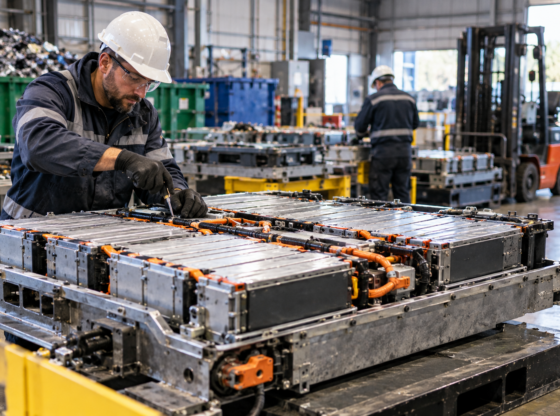

The battery story does not end when an electric vehicle leaves the road.
For years, most attention around electric vehicle batteries has focused on what happens before they reach a car: how much energy they can store, how quickly they charge and how far they can take a vehicle. Now another part of the battery lifecycle is becoming increasingly important. As the global electric vehicle fleet grows, manufacturers, recyclers and energy companies are preparing for a much larger flow of batteries that are no longer suitable for demanding automotive use.
This is turning battery recycling into more than a waste-management issue. It is becoming part of the industrial supply chain.
The International Energy Agency says used and end-of-life EV battery markets are still at an early stage, but falling prices for used batteries are already creating new opportunities for recyclers and companies developing second-life applications. At the same time, a 2026 review in Nature Energy warns that recycling capacity will need to expand significantly from 2026 onward as battery production continues to grow and the range of battery chemistries becomes more diverse.
The result is a new question for the battery industry: what is the most valuable thing to do with a battery when it is no longer good enough for a car?
An EV Battery Can Outlive the Vehicle
A battery does not suddenly become useless when its performance falls below the level required by an electric car.
Automotive batteries operate under demanding conditions. Drivers expect reliable acceleration, predictable range and fast charging, while manufacturers have to maintain strict standards for safety and performance. Over time, repeated charging cycles, temperature exposure and normal chemical aging reduce the amount of energy a battery can store and deliver.
For an electric vehicle, that decline eventually becomes significant. For a stationary energy-storage system, however, the same battery may still have considerable value.
Research published in 2026 continues to place the typical remaining capacity of retired EV batteries in the range of roughly 70% to 80%, depending on how the battery was used and its condition. That remaining capacity can potentially be used for less demanding applications such as stationary energy storage.
This creates the idea of a battery’s second life.
Instead of immediately dismantling an old battery and recovering its materials, companies can test individual cells or modules, evaluate their remaining health and assemble suitable components into a new storage system.
The concept sounds straightforward. In practice, it is considerably more complicated.
The Hard Part Is Knowing What the Battery Still Can Do
A battery pack that has spent years inside an electric vehicle is not necessarily uniform.
Some cells may have degraded faster than others. The battery may have experienced different charging patterns, temperatures and operating conditions. Its electronic systems may also be closely integrated with the original vehicle.
That makes battery diagnostics one of the most important technologies in the emerging second-life market.
Before a retired pack can be reused, operators need to understand its state of health and estimate how much useful life remains. They also need to determine whether the battery can operate safely in its new role.
This is one reason artificial intelligence and advanced battery-management systems are becoming increasingly relevant. A 2026 review of second-life lithium-ion batteries highlighted the growing role of state-of-health estimation, remaining-useful-life prediction and specialized battery-management systems in deciding whether batteries can be safely and economically repurposed.
Better diagnostics could eventually make the process much more efficient. Instead of treating an entire battery pack as a single object, recycling and reuse companies can increasingly make decisions at the cell, module or pack level.
That distinction matters because the value of a battery may depend less on its age than on its actual condition.
Stationary Storage Is the Most Obvious Second Career
The growth of renewable electricity is creating a natural market for batteries that no longer meet automotive requirements.
Solar panels produce most of their electricity during daylight hours, while demand often continues after the sun goes down. Wind generation can also fluctuate depending on weather conditions. Stationary batteries can help store electricity during periods of high production and release it when the grid needs additional power.
Unlike a car battery, a stationary storage system does not need to carry its own weight down a highway.
That changes the economics.
A battery with reduced energy density can still be useful when it is installed permanently in a building, industrial facility or larger energy-storage system. The lower demands of stationary applications can therefore extend the useful life of materials that would otherwise move directly into recycling.
Several commercial projects are already testing this model. In 2026, BSI highlighted projects using repurposed EV batteries in energy-storage systems, including installations associated with Audi, Nissan and B2U Storage Solutions. The organization also noted the opening of a large battery-repurposing facility in Canada.
The market is still developing, but the direction is clear. An electric vehicle battery can potentially move from transportation into stationary energy before its materials are finally recovered.
Reuse Will Not Always Be the Best Option
The idea of giving every EV battery a second life sounds attractive, but it is not always the most efficient solution.
New battery prices have fallen significantly. That changes the calculation for companies deciding whether to install an old battery or purchase a new one. If a new battery offers better performance at a similar total cost, the economic case for repurposing an older pack becomes weaker.
There are also practical challenges. A used battery must be removed from the vehicle, transported, inspected, dismantled and rebuilt. Every step requires equipment, skilled workers and safety procedures. The company taking responsibility for the second-life system also inherits questions about warranties, liability and future disposal.
The IEA has highlighted these difficulties, noting that second-life applications face challenges involving safety requirements, uncertainty about remaining battery life, dismantling costs and the falling price of new batteries.
This means the battery industry will not simply choose between reuse and recycling. It will increasingly need to determine which option creates the greatest value for each individual battery.
A healthy battery with substantial remaining capacity may be suitable for another application. A heavily degraded or damaged battery may be better sent directly into a recycling process.
Recycling Is Becoming a Source of New Materials
When a battery finally reaches the end of its useful life, its materials do not necessarily have to become waste.
Modern recycling processes can recover valuable elements from battery cells and return them to industrial supply chains. Depending on the chemistry and process, recovered materials can include lithium, nickel, cobalt, copper and other components.
This is particularly important because battery manufacturing requires enormous quantities of raw materials. Recycling cannot eliminate the need for mining, especially while battery demand continues to grow, but it can create another source of materials and reduce dependence on newly extracted resources.
The European Commission made this connection explicit in September 2026 when it reviewed battery recycling targets under the European Union’s Batteries Regulation. The Commission concluded that the existing targets remained appropriate and emphasized the importance of keeping critical materials in circulation to support a more resilient battery supply chain.
The regulation sets progressively higher recovery targets for materials including cobalt, copper, nickel and lithium. By 2031, the EU framework calls for recovery of 95% of cobalt, copper, lead and nickel and 80% of lithium from relevant battery waste streams.
These targets show how recycling is moving from a secondary environmental concern toward a strategic industrial priority.
The Recycling Industry Faces a New Kind of Complexity
Battery recycling is becoming more difficult for an unexpected reason: there are more types of batteries than before.
For years, recyclers could build processes around relatively familiar lithium-ion chemistries. The market is now expanding to include LFP, LMFP, sodium-ion and emerging solid-state technologies.
A 2026 Nature Energy review found that established recycling processes are broadly suitable for many current lithium-ion batteries, but future chemistries will require process adaptations. The researchers also identified the growing variety of cell designs, formats and chemical compositions as a major challenge for recycling economics and logistics.
That means the recycling plant of the future cannot simply be designed around one standard battery.
It needs to identify what has arrived at the facility, separate different materials and chemistries and choose an appropriate recovery process. As battery designs continue to change, recycling companies will have to become more flexible.
This may sound like an industrial detail, but it could have a direct effect on the cost of electric vehicles and energy storage. If batteries are easier to dismantle and recycle, more of their material value can potentially be recovered. If they are difficult to identify or disassemble, recycling becomes more expensive.
Battery Design Could Start Changing Because of Recycling
The next major development may therefore happen before a battery ever reaches a recycling facility.
Manufacturers are increasingly thinking about the entire lifecycle of a battery rather than treating production and disposal as separate stages. Design decisions can influence how easily a battery can be repaired, dismantled, tested and recycled later.
This creates an interesting feedback loop.
The batteries entering the market today will eventually become tomorrow’s recycling feedstock. If manufacturers make them easier to diagnose and disassemble, recycling companies can operate more efficiently. If battery packs remain difficult to open or contain increasingly complex combinations of materials, the cost of recovering those materials may rise.
The Fraunhofer Research Institution for Battery Cell Production warned in July 2026 that the volume of end-of-life batteries and materials requiring recycling could triple by 2030. The study also highlighted the growing complexity of different battery types, designs and chemical compositions.
That makes today’s design decisions relevant to an industry that is still building its infrastructure.
The Battery Economy Is Becoming Circular
The traditional battery model was relatively simple: extract materials, manufacture cells, install them in products and eventually dispose of them.
That model becomes difficult to sustain when batteries are deployed on a massive scale.
A more circular system is beginning to emerge. Materials are extracted and turned into batteries, batteries are used in vehicles, suitable packs may receive a second life in stationary storage, and the remaining materials can eventually be recovered and returned to manufacturing.
Not every battery will follow the same path. Some will be repaired or reused. Others will go directly to recycling. Some will remain inside second-hand vehicles for many more years before they reach either destination. The IEA notes that the expansion of the used EV market may delay the arrival of some batteries at recycling facilities because vehicles and their batteries continue to operate after being resold.
This is important because the future supply of recyclable battery materials will not simply depend on how many electric vehicles are sold today. It will also depend on how long those vehicles remain in service, how batteries are maintained and where they eventually reach the end of their useful lives.
The Next Battery Race Will Include the End of the Battery
The battery industry has spent years trying to build cells that last longer, charge faster and store more energy. Now another measure of battery performance is becoming increasingly important: what happens after the first life is over.
A successful battery may eventually be judged not only by the kilometres it enables or the electricity it stores, but also by how easily its remaining value can be recovered.
That does not make recycling a substitute for better batteries. It makes recycling part of better battery technology.
The companies that can diagnose used cells accurately, reuse them safely, recover valuable materials efficiently and feed those materials back into production will have an increasingly important role in the energy economy.
As millions more batteries move through transportation and electricity systems, the end of a battery’s first life will increasingly look less like an ending and more like another stage in the manufacturing cycle.