

For more than a decade, the battery industry has revolved around one dominant chemistry: lithium-ion. It became the foundation of smartphones and laptops, then moved into electric vehicles, grid storage and a growing range of industrial applications. But as batteries become one of the most strategically important technologies in the global economy, the industry is beginning to question whether lithium-ion should remain the answer to every problem.
In 2026, that question is becoming much more practical. Sodium-ion batteries, once largely associated with laboratories and long-term research, are moving into commercial production and large-scale energy storage. The International Energy Agency says the technology has entered a scale-up phase, with major manufacturers developing products for both vehicles and stationary storage.
That does not mean lithium-ion is about to disappear. In fact, lithium-based batteries remain far more mature and continue to hold important advantages. What is changing is the assumption that every battery application needs the same chemistry.
The next phase of battery development may therefore be less about finding a single replacement for lithium-ion and more about matching different battery technologies to different jobs.
Why Sodium Is Suddenly Getting Serious Attention
At first glance, sodium may seem like an obvious substitute for lithium. Both elements can be used to move ions between electrodes during charging and discharging, which means sodium-ion batteries share many fundamental principles with the lithium-ion systems already used throughout the electronics and automotive industries.
The attraction lies partly in the materials themselves. Sodium is widely available, while lithium supply is concentrated in a relatively small number of producing regions and remains exposed to changes in global demand, mining capacity and commodity prices. For battery manufacturers trying to build resilient supply chains, having another chemistry available could reduce dependence on a single group of raw materials.
The International Energy Agency identifies supply-chain diversification as one of the main potential advantages of sodium-ion technology. Sodium-ion batteries can also perform particularly well in cold conditions. According to the IEA, newer sodium-ion designs can retain around 90% of nominal capacity at temperatures as low as -40°C, although performance varies between technologies and applications.
That characteristic could become particularly useful in applications where extreme temperatures are a significant operating challenge. It also illustrates why battery competition is no longer simply about which technology has the highest energy density.
A battery can be valuable because it is inexpensive, durable, resistant to temperature changes or easier to manufacture, even if it stores less energy per kilogram than the best lithium-ion cells.
The Biggest Change Is Happening at the Factory
The most important development in sodium-ion technology is not a laboratory demonstration. It is the growing ability to manufacture the cells at industrial scale.
In April 2026, CATL presented its Naxtra sodium-ion battery alongside a broader group of new battery technologies and said the product was moving from technological development toward large-scale manufacturing. The company said it had addressed several engineering problems that had previously limited mass production and expected Naxtra to enter full-scale production by the end of 2026.
That transition matters because battery technology is ultimately a manufacturing problem as much as a chemistry problem.
A cell can perform exceptionally well in a laboratory and still fail commercially if it is too expensive to manufacture, difficult to assemble consistently or dependent on materials that cannot be supplied in sufficient quantities. The lithium-ion industry spent decades building factories, refining production processes and creating a global ecosystem around cell manufacturing. New battery chemistries have to compete with that enormous industrial advantage.
Sodium-ion technology has another potential advantage: much of the knowledge developed for lithium-ion manufacturing can be adapted rather than discarded entirely. The basic architecture is similar enough that manufacturers can draw on existing expertise in electrode production, cell assembly and battery management.
Research published in 2026 also highlights the growing commercial maturity of sodium-ion batteries, while noting that important challenges remain in areas such as energy density, modelling and battery-management systems.
The result is a technology that is no longer simply waiting for a scientific breakthrough. It is now facing the harder questions of cost, scale, reliability and market positioning.
Energy Density Still Gives Lithium an Important Advantage
There is one reason lithium-ion is unlikely to lose its position quickly: energy density.
For electric vehicles, every kilogram matters. A battery that stores more energy without becoming significantly heavier can provide greater driving range, reduce vehicle weight or create additional space for other components. That advantage remains difficult for sodium-ion batteries to overcome.
The IEA explicitly notes that sodium-ion batteries currently have lower energy density than lithium-ion alternatives, limiting their competitiveness with lithium iron phosphate, or LFP, batteries at current lithium prices.
This distinction is important because LFP itself has already changed the battery market. It offers a different balance of cost, durability and energy density from nickel-rich chemistries, and has become a major choice for mainstream electric vehicles and stationary storage.
Sodium therefore does not need to defeat every form of lithium-ion technology to become successful. It only needs to become particularly attractive in applications where its weaknesses matter less.
That could include stationary energy storage, lower-cost vehicles, commercial transport and applications where cold-weather performance or material availability is more important than achieving the maximum possible range.
Grid Storage Could Become Sodium-Ion’s Natural Home
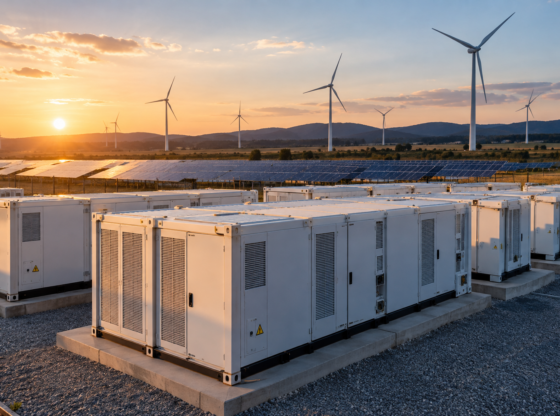
The expansion of renewable electricity is creating a battery market that looks very different from the one built around smartphones and cars.
A grid battery does not need to carry passengers down a highway. It does not need to fit underneath a vehicle floor. It can be large, stationary and designed around a different set of priorities.
Its job may simply be to store electricity when solar generation is high, release it when demand rises, smooth short-term fluctuations or provide flexibility when the grid is under pressure.
That market is expanding rapidly. The IEA’s 2026 electricity outlook says utility-scale battery deployment is accelerating and becoming an increasingly important source of short-term flexibility for power systems with growing amounts of solar and wind generation.
This creates an opening for chemistries that are not necessarily the best choice for a premium long-range electric car.
CATL is already pushing sodium-ion storage in this direction. In June 2026, the company announced its TENER Sodium energy-storage system and said the technology had reached commercial maturity across technology, production and supply-chain readiness. CATL also announced plans for large-scale sodium-ion production capacity and international deliveries beginning in 2027.
The company and HyperStrong had previously announced a three-year, 60 GWh sodium-ion energy-storage agreement, another indication that the technology is beginning to attract commitments measured in industrial rather than experimental quantities.
These developments suggest that stationary storage may become one of the first places where sodium-ion technology can prove its economic case at scale.
Batteries Are Becoming a Portfolio of Technologies
The larger story is not really about sodium replacing lithium. It is about the battery industry becoming more diversified.
Lithium-ion itself is already a family of different technologies. LFP batteries serve different priorities from nickel-manganese-cobalt cells. High-power cells are engineered differently from energy-dense cells. Hybrid systems increasingly combine different approaches to meet specific requirements.
Sodium-ion adds another option to that increasingly complex landscape.
At the same time, solid-state batteries are moving through their own development cycle. A 2026 TrendForce assessment found that all-solid-state batteries had entered an engineering-validation phase, with companies including Toyota, Honda, Nissan and Samsung SDI advancing pilot production and automotive testing.
Companies working on solid-state systems are still dealing with major manufacturing and scaling challenges. QuantumScape, for example, inaugurated its Eagle pilot-production line in early 2026, describing it as a production blueprint intended to support customer sampling and technology integration.
This means the battery landscape is beginning to resemble the semiconductor industry more than a single-product market. Different architectures can coexist because different applications place different demands on the underlying technology.
The Real Competition Will Be About Cost and Reliability
Battery headlines often focus on spectacular numbers: faster charging, longer range, higher energy density or a new laboratory record. Those achievements matter, but commercial success is determined by a much wider equation.
Manufacturers need cells that can be produced millions of times with consistent quality. Automakers need predictable supply. Energy companies need systems that can operate for years. Consumers need batteries that maintain useful performance over long periods.
This is why sodium-ion’s progress deserves attention even if it does not immediately deliver the same range as the most advanced lithium-ion batteries.
A chemistry that uses abundant materials, performs well in difficult temperatures and can be manufactured economically could become extremely valuable when deployed at enormous scale.
The battery industry is also beginning to think more seriously about what happens after a battery reaches the end of its first life. Research published in 2026 has highlighted closed-loop recycling and cathode resynthesis as important areas for reducing material waste and recovering valuable components from retired lithium-ion batteries.
That means the future battery system will not end when a vehicle leaves the road. Cells may move into stationary applications, be dismantled for material recovery and eventually contribute to new batteries.
A More Diverse Battery Economy Is Taking Shape
For years, the battery race was often described as a search for the technology that would finally replace lithium-ion. That framing is becoming less convincing.
The industry is moving toward something more complicated and potentially more useful: a battery economy in which several chemistries coexist.
Lithium-ion will remain essential because its manufacturing ecosystem is enormous and its energy-density advantages are difficult to match. Sodium-ion can address applications where cost, material availability, temperature performance and supply-chain diversification are more important. Solid-state technologies are being developed for a future in which higher energy density and improved safety could justify more complex manufacturing.
Meanwhile, grid storage is creating an entirely new market in which batteries are no longer judged primarily by how far a vehicle can travel.
That diversity could ultimately be the biggest change of all. Instead of asking which battery will win, manufacturers are increasingly asking a more practical question: which battery is best suited to this particular job?
As battery demand expands across transportation, electricity networks and consumer technology, that shift could make the next decade less about a single breakthrough and more about learning how to use several different breakthroughs together.