
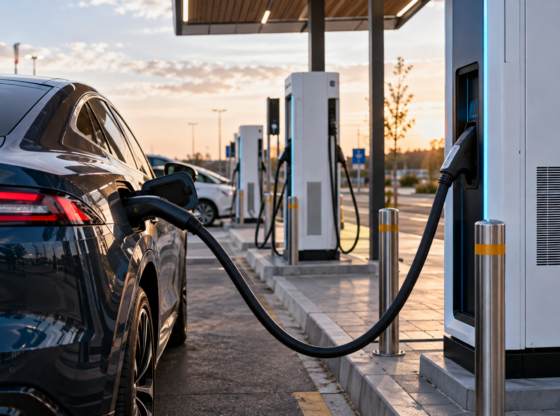

Charging an electric car is becoming much faster, but the most interesting change is happening beyond the charging time shown on a dashboard.
The latest charging stations are being designed with power levels that would have seemed extraordinary only a few years ago. In 2026, new systems are moving beyond 250 kW, while some manufacturers are already demonstrating chargers capable of delivering more than 1 MW.
The surprising part is that most electric cars cannot use that much power.
This gap is becoming one of the defining features of the charging market. Charging networks are preparing for a future generation of electric vehicles, while today’s cars are still limited by their batteries, electrical systems and charging architecture.
The result is a charging race in which infrastructure is moving ahead of vehicle capability.
Charging Networks Are Getting Faster
Public charging infrastructure expanded rapidly during 2025. The International Energy Agency estimates that the global number of public charging points passed 7 million by the end of the year after almost 1.8 million new points were added. The global average charging speed also increased as fast and ultra-fast chargers became a larger part of the network.
The change is particularly visible at highway charging sites.
A conventional public charger can provide useful energy over a relatively long stop. A high-power charger is designed around a different experience. Drivers can arrive with a low battery, connect the vehicle and add a substantial amount of range during a short break.
The technology is moving quickly.
The IEA classifies chargers above 150 kW as ultra-fast and notes that next-generation systems are already exceeding 250 kW. In 2025, around 160 battery-electric vehicle models were known to support charging above 150 kW, although far fewer could use more than 250 kW.
That distinction is important because a charger can be much more powerful than the vehicle connected to it.
The Charger Is Not the Only Limit
It is easy to assume that plugging an electric car into a more powerful charger will automatically make it charge faster.
It does not.
The vehicle determines how much electricity it can accept. The battery has a maximum charging rate, and the car’s electronics regulate the power entering the pack. Battery temperature, state of charge and other conditions can also affect the charging curve.
This means a 350 kW charger does not necessarily charge every car at 350 kW.
The same principle applies to even more powerful equipment. A vehicle connected to a megawatt charger will only take the power its battery and charging system can safely handle.
That explains why the infrastructure is advancing so quickly even though relatively few cars can use its full capacity.
Charging companies are preparing for the next generation of vehicles rather than building only for the cars already on the road.
Megawatt Charging Is Changing the Conversation
The clearest example is the move toward megawatt-scale charging.
In early 2026, BYD unveiled charging systems capable of delivering up to 1.5 MW for passenger vehicles. The company said compatible vehicles could add hundreds of kilometres of range during a very short charging session.
A megawatt is an enormous amount of electrical power.
For comparison, many existing public fast chargers operate at a few hundred kilowatts. Moving into the megawatt range therefore requires much more than simply installing a larger charging cable.
The entire electrical system around the charger has to be designed for the load.
Cables, cooling equipment, power electronics, transformers and connections to the grid all become more important. The charging site may also need additional infrastructure to manage demand when several vehicles charge at the same time.
For heavy trucks, the argument for megawatt charging is even stronger.
A commercial truck cannot always afford to spend hours parked while its battery charges. Every additional hour can reduce the amount of time the vehicle spends working. High-power charging could therefore become an important part of the economics of electric freight.
Batteries Are Being Designed Around Faster Charging
The charging race is also changing battery development.
For many years, increasing battery capacity was the simplest way to extend driving range. Manufacturers could put more cells into a vehicle and give it a larger energy reserve.
That approach has limits.
A larger battery adds weight and cost. It can also require more materials and take longer to charge. As public charging networks become faster, manufacturers have another way to improve the ownership experience: allow the battery to recover energy more quickly.
The IEA says the first 1,000-volt electric vehicle models appeared in 2025, while announcements of charging times below ten minutes continued into 2026. Higher-voltage systems allow manufacturers to deliver more power without requiring the same increase in current, which can improve efficiency and reduce some electrical losses.
This is one reason charging technology cannot be separated from battery technology.
A high-power charger is useful only when the vehicle has been engineered to accept that power.
Ten-Minute Charging Is Becoming a Real Engineering Target
Ultra-fast charging is also changing what consumers consider a normal charging stop.
For years, electric vehicle charging was often compared with filling a petrol tank. The comparison made sense because drivers were accustomed to short refuelling stops.
Modern charging technology is challenging that comparison from a different direction.
Instead of trying to reproduce the exact experience of a fuel station, manufacturers are reducing the amount of time drivers need to spend at a charger. If a vehicle can add most of its useful range during a short coffee break, charging becomes less disruptive.
The IEA estimates that charging for 15 minutes at a 150 kW charger can provide almost 180 kilometres of mixed driving range for vehicles capable of accepting that power.
The figure varies considerably between vehicles because charging speed is not constant throughout the session.
A battery usually accepts its highest power at a lower state of charge. As the battery fills, the vehicle reduces the charging rate to protect the cells and manage heat.
That means the fastest possible charging figure does not tell the whole story.
The Charging Curve Matters More Than the Peak Number
This is becoming an important distinction in the market.
Two vehicles can advertise similar maximum charging power but deliver very different real-world charging experiences.
One may reach its peak briefly and then reduce power sharply. Another may maintain a high charging rate for longer.
For drivers, the second vehicle can be more useful even if its headline charging number is lower.
Battery temperature also matters. A cold battery may not accept high power immediately, while a battery that becomes too hot can also require reduced charging power.
Modern electric vehicles therefore use increasingly sophisticated thermal-management systems to prepare the battery for rapid charging.
Some vehicles can precondition the battery before reaching a fast-charging station. The system adjusts the battery temperature so that the cells can accept power more efficiently when charging begins.
That kind of software and thermal management is becoming as important as the charger itself.
The Grid Is Becoming Part of the Charging Problem
There is another issue behind the move toward ultra-fast charging.
Electricity.
A charging station with several megawatt-class chargers can place a substantial load on the local grid. If many vehicles arrive at the same time, the demand can become even greater.
The IEA warns that rising charging speeds and EV adoption could make grid-capacity constraints more significant in some regions. Global electricity demand from EVs could exceed 1,500 TWh by 2035 under current policies, although this would still represent only around 4% of total global electricity demand.
The challenge is therefore not simply producing enough electricity.
The electricity has to reach the right place at the right time.
A highway charging station may need a stronger grid connection than the surrounding area previously required. Urban charging hubs can create concentrated demand in locations where local distribution networks were not designed for such loads.
This is why charging infrastructure increasingly involves utilities, grid operators and energy-storage companies.
Smart Charging Could Reduce the Pressure
The solution will not always be to build bigger electrical connections.
Sometimes the better approach is to manage when vehicles charge.
Smart charging systems can shift charging to periods when electricity demand is lower. They can also respond to electricity prices or local grid conditions.
If thousands of vehicles are connected to chargers overnight, for example, a coordinated system can distribute their charging demand instead of allowing every vehicle to draw maximum power at the same moment.
This turns charging from a passive activity into an active part of the electricity system.
The IEA expects smart charging to become increasingly important as EV adoption grows. It can reduce peak demand and help utilities manage new electricity loads without immediately requiring major grid upgrades.
The same infrastructure could eventually support another technology: vehicle-to-grid charging.
Cars Could Eventually Send Electricity Back
Bidirectional charging allows electricity to move in both directions.
Instead of simply taking electricity from the grid, an electric vehicle can potentially send some of its stored energy back.
That creates several possibilities.
A vehicle could charge when electricity is inexpensive and return energy to the grid during periods of high demand. It could also provide backup power to a building or help a household manage electricity consumption.
Commercial vehicle fleets could be particularly useful because trucks and vans often have predictable schedules. Their batteries could remain connected for long periods and provide grid services when they are not being driven.
The technology is still developing. The IEA says commercial V2G offers for private EV owners appeared in 2025, but relatively few vehicles support the technology and regulatory frameworks remain fragmented.
For now, bidirectional charging is therefore an emerging capability rather than a standard feature.
Its importance could grow as more electric vehicles enter the grid.
Compatibility Is Becoming Easier in Some Markets
Charging infrastructure also has another problem to solve: different connectors and standards.
In North America, the North American Charging Standard, or NACS, has gained significant adoption. Tesla’s connector has been incorporated into SAE J3400, giving the system a formal industry standard rather than leaving it as a proprietary design.
Tesla has also opened parts of its Supercharger network to compatible non-Tesla vehicles. Some vehicles now come with NACS ports from the factory, while others can use adapters.
Greater standardisation can make charging easier for drivers.
The ideal experience is simple: arrive at a station, connect the car and start charging without worrying about which network operates the charger or which connector the vehicle uses.
That experience is not universal yet.
However, the direction is clear. The industry is moving toward greater interoperability.
The Future Charger May Be More Than a Plug
The fastest charger is not necessarily the best charger.
A good charging system needs to do several things at once. It must deliver power quickly, communicate with the vehicle, manage heat, protect the electrical system and interact with the wider grid.
As charging speeds increase, those functions become more important.
The charger is becoming an intelligent energy device rather than a simple connection between a car and an electricity supply.
This is particularly important because most charging still happens away from public fast-charging stations. The IEA estimates that more than 43 million private light-duty charging points existed globally in 2025, and home charging remains the preferred option for drivers who have access to it.
Public ultra-fast charging therefore serves a different purpose.
It is primarily about mobility when drivers are away from home, especially during long journeys and for commercial vehicles that cannot remain parked for extended periods.
The Charging Race Is Moving Into Its Next Phase
The biggest change in EV charging is not simply that chargers are becoming more powerful.
It is that the entire system is becoming more coordinated.
Batteries are being designed for higher charging rates. Vehicles are moving to higher-voltage electrical architectures. Charging stations are reaching hundreds of kilowatts and, in some cases, megawatt levels. Software is managing battery temperature and charging schedules, while utilities are preparing for larger and more variable electricity demand.
Yet the most powerful chargers remain ahead of what most cars can use.
That is not necessarily a sign of wasted infrastructure. It is evidence that charging networks are being built for the next generation of electric vehicles.
The challenge now is to make the different parts of the system develop at roughly the same pace.
A 1.5 MW charger is impressive, but its value depends on the battery connected to it. A highly capable battery is less useful if the surrounding charging network cannot deliver enough power. And an expanding charging network becomes much harder to operate if the local electricity system cannot handle its demand.
The future of charging will therefore be determined by coordination as much as by speed.
The winning technology may not be the charger with the biggest number on its specification sheet. It may be the system that can deliver the right amount of power, at the right time, to the right vehicle, without creating unnecessary pressure on the grid.
That is a much bigger challenge than simply making charging faster. It is also what could make electric mobility feel genuinely convenient at large scale.