
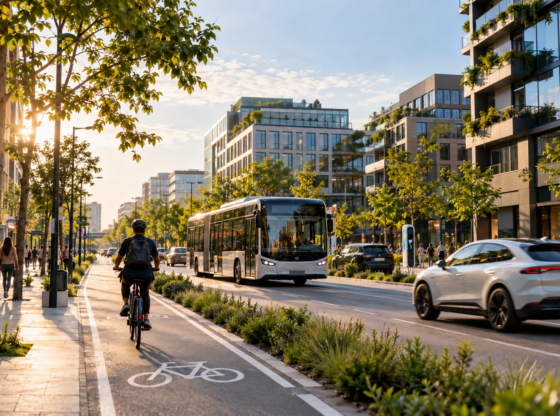

For decades, the basic structure of urban transportation changed surprisingly little. People drove cars to work, took buses when convenient, walked short distances and increasingly relied on trains and metro systems in larger cities. The technologies evolved, but the underlying idea remained familiar: mobility was largely built around moving individual people as efficiently as possible from one point to another.
That model is now being reconsidered.
The growth of electric vehicles is an important part of the change, but sustainable mobility is becoming a much broader concept. Cities are looking at public transport, cycling infrastructure, pedestrian access, shared mobility, charging networks, traffic management and the relationship between housing and transportation. The objective is increasingly not simply to replace petrol and diesel vehicles with electric ones, but to create transportation systems that use less energy and space while remaining practical for everyday life.
The scale of the transition is already visible. The International Energy Agency estimates that global electric-car sales exceeded 20 million in 2025, meaning one in four new cars sold worldwide was electric. At the same time, the IEA expects electric mobility to expand rapidly across cars, buses, trucks and two- and three-wheelers over the coming decade.
The more interesting question is what happens when electrification becomes only one part of a much larger mobility transformation.
Electric Cars Are Only the Beginning
Electric vehicles have become the most visible symbol of sustainable transportation because they offer a relatively straightforward way to reduce direct emissions from road travel.
A battery-electric car produces no tailpipe emissions while driving, and the overall climate advantage becomes greater as electricity generation becomes cleaner. According to the IEA, the global EV fleet avoided around 190 million tonnes of CO2-equivalent emissions in 2025 when considering well-to-wheel impacts. Under current-policy projections, cumulative avoided emissions from EV adoption could reach roughly 7 gigatonnes between 2025 and 2035.
Those numbers demonstrate why electrification matters.
But they also reveal its limits.
Replacing every conventional car with an electric equivalent does not automatically solve congestion, parking demand, road construction, traffic noise or the amount of urban space dedicated to private vehicles. An electric traffic jam is still a traffic jam. An electric SUV still occupies roughly the same road space as a conventional SUV.
That is why sustainable mobility is increasingly being discussed as a system rather than a powertrain.
The City Is Becoming the Main Mobility Laboratory
Urban areas are where different forms of transportation meet, and that makes them the most important testing ground for new mobility policies.
The basic question is changing from “How can we make cars cleaner?” to “How should people move around the city in the first place?”
That can mean improving public transport so that buses and trains become more convenient than driving for certain journeys. It can mean creating safer cycling routes that make bicycles practical for commuting rather than recreational use. It can mean redesigning streets so pedestrians do not have to compete with fast-moving traffic at every intersection.
The European Commission’s updated 2026 Sustainable Urban Mobility Planning guidelines reflect this broader approach. The latest guidance emphasizes sustainable, inclusive and efficient transport planning and is being reinforced by European requirements for hundreds of urban nodes to adopt Sustainable Urban Mobility Plans by the end of 2027.
The significance of this shift is that transportation policy is increasingly being integrated with wider decisions about how cities are built.
Where people live, where offices are located, how schools are accessed and where essential services are placed can all influence how much transportation is required in the first place.
Public Transport Is Regaining Strategic Importance
Electric cars receive much of the attention surrounding sustainable mobility, but public transport can have a much larger effect on how efficiently cities move people.
A full electric bus can replace a significant amount of private-car travel while carrying many passengers in a single vehicle. Rail systems can move large numbers of people using relatively little urban space. When public transport is reliable and frequent, it can reduce the need for households to depend on private cars for every journey.
Electrification is making these systems cleaner as well.
Electric buses are becoming an increasingly important part of the global EV transition. The IEA expects the global share of electric buses in new sales to approach 25% by 2035 under its stated-policies scenario, while electric trucks and buses together are projected to displace significant quantities of diesel and gasoline use.
The challenge is no longer simply buying electric buses. Cities also need depots capable of charging large fleets, electricity connections that can handle peak demand, maintenance expertise and operational schedules that work with the characteristics of electric vehicles.
That makes public-transport electrification both a technology project and an infrastructure project.
The Rise of Smaller Electric Vehicles
Another important development is taking place below the level of the conventional passenger car.
Electric bicycles, scooters, mopeds and three-wheelers are becoming increasingly significant in many markets. They require considerably less energy than cars and occupy far less road space, making them particularly relevant to dense urban environments.
The IEA expects electric two- and three-wheelers to expand rapidly through 2035. In its stated-policies scenario, their global stock reaches around 300 million by 2035, roughly four times today’s level. Their adoption is particularly strong in commercial applications because their lower operating costs can make a direct economic difference to delivery and transport businesses.
This part of the mobility transition is sometimes overlooked because electric bicycles and scooters do not attract the same attention as new electric cars.
Yet their potential is substantial.
A person travelling several kilometres across a city does not necessarily need a two-tonne vehicle. For many journeys, a lighter electric vehicle can provide enough range and speed while consuming a fraction of the energy.
The challenge is creating streets where these different forms of mobility can coexist safely.
Micromobility Needs Better Infrastructure
The expansion of bicycles and smaller electric vehicles creates an infrastructure problem of its own.
Simply putting more electric bicycles on existing roads does not automatically make a city more sustainable. If cyclists are forced to share high-speed roads with cars, adoption can remain limited because many people will consider the journey unsafe.
Infrastructure therefore becomes as important as the vehicles themselves.
Protected cycling routes, secure bicycle parking, charging points for light electric vehicles and connections between cycling networks and public transport can turn individual technologies into a functioning mobility system.
This is one reason urban mobility planning is becoming more comprehensive. The European Commission’s 2026 guidance specifically includes cycling within the broader Sustainable Urban Mobility Planning framework, reflecting the idea that bicycles should be treated as part of the transportation network rather than an optional recreational feature.
The same principle applies to pedestrians.
A city can have thousands of electric vehicles and still have poor mobility if people cannot safely walk between homes, transit stops, workplaces and local services.
Sustainable Mobility Is Also About Distance
One of the least discussed aspects of sustainable transport is the distance people need to travel.
A highly efficient vehicle does not necessarily create a highly efficient transportation system if people have to make long journeys for basic services every day.
This is where urban planning and mobility policy begin to overlap.
Mixed-use neighbourhoods, accessible public services and employment centres connected by reliable transport can reduce the number of journeys that require a private car. The benefit is not simply lower emissions. Shorter journeys can also reduce congestion, travel costs and the amount of time people spend moving through the city.
The idea is sometimes described as “mobility reduction”, but that does not mean preventing people from travelling. It means reducing unnecessary travel by making everyday destinations easier to reach.
That distinction is becoming increasingly important as cities try to manage both transportation emissions and limited urban space.
Digital Technology Is Connecting the System
Sustainable mobility is also becoming more dependent on software.
Journey-planning platforms can combine buses, trains, bicycles and walking routes into a single trip. Real-time information can help passengers choose different routes when services are delayed. Smart traffic systems can adjust signals according to actual traffic conditions rather than fixed schedules.
Electric vehicles introduce another layer.
Charging can be scheduled to avoid periods of high electricity demand, while connected vehicles can potentially return electricity to the grid through vehicle-to-grid systems. The IEA notes that smart charging and V2G could provide additional flexibility as EV adoption grows, although the availability of compatible vehicles, standards and regulatory frameworks remains limited in many markets.
This means the sustainable mobility system of the future may be partly physical and partly digital.
Roads, railways and charging stations remain essential, but software increasingly determines how efficiently those assets are used.
The Electricity Question Cannot Be Ignored
Electrifying transportation does not eliminate the need for energy. It changes where and when that energy is consumed.
The IEA estimates that the global EV fleet consumed around 250 TWh of electricity in 2025, approximately 1% of final electricity demand worldwide. Under current policies, electricity demand from EVs could exceed 1,500 TWh by 2035.
That sounds enormous, but in global terms the additional demand remains manageable. The IEA estimates that EV electricity consumption could represent around 4% of total global electricity demand in 2035 under its current-policies scenario.
The more difficult issue is local.
A neighbourhood with thousands of electric cars charging at the same time can create a very different challenge from the global electricity system. Distribution networks may need upgrades, and charging demand can become concentrated at particular times of day.
Smart charging is therefore becoming increasingly important. If vehicles can charge when electricity demand is lower, the same infrastructure can support more EVs without requiring every part of the grid to be expanded immediately.
Sustainability Is Becoming a Question of Space
There is another resource that transportation policy increasingly has to consider: urban space.
Roads, parking areas, garages, cycle lanes, sidewalks and public transport corridors all compete for limited land.
Electric vehicles can reduce local air pollution and dependence on fossil fuels, but they do not reduce the physical footprint of private-car travel. A sustainable city therefore has to think about how much space each mode of transportation requires relative to the number of people it moves.
This is where public transport, walking and cycling have an inherent advantage.
A bus carrying dozens of passengers can use the same road space as a small number of cars while moving considerably more people. A bicycle requires a fraction of the space of a car, both when moving and when parked.
That does not mean private cars will disappear. For many people, they remain essential because of distance, accessibility, work requirements, family responsibilities or inadequate public transport.
The realistic goal is therefore not to eliminate one mode of transportation, but to create a system in which people have more viable choices.
The Next Stage Will Be About Integration
The first stage of sustainable mobility was largely about cleaner vehicles.
The next stage is about connecting them.
An electric car becomes more useful when it can charge from a cleaner electricity system. A train becomes more attractive when passengers can easily reach the station by bicycle. An electric bus becomes more effective when routes are frequent enough to compete with private cars. A shared mobility service becomes more valuable when it is integrated into a wider public transport network.
None of these solutions works particularly well in isolation.
That is why the most successful mobility strategies are likely to combine several approaches rather than betting everything on one technology.
The IEA’s latest outlook reinforces this point. Electric vehicles are expanding rapidly, but their contribution to emissions reduction depends on continued improvements in vehicle efficiency, electricity generation, infrastructure and policy. Under current policies, EV adoption could avoid more than 1 gigatonne of greenhouse-gas emissions in 2035 alone, while stronger policies and cleaner electricity could increase the benefit substantially.
A Different Definition of Mobility
The most important change in sustainable mobility may therefore be conceptual.
Transportation is no longer being judged only by how quickly a vehicle can move from one place to another. Cities and governments are increasingly asking how much energy a journey requires, how much space it consumes, how accessible the system is, whether different transport modes connect efficiently and what environmental cost is associated with the entire trip.
Electric vehicles will remain central to that transition. Their global growth is already large enough to influence oil demand, electricity consumption and automotive manufacturing. But the broader transformation reaches beyond the car.
The sustainable mobility system taking shape now is likely to be more diverse: electric cars alongside buses and rail, bicycles alongside shared mobility, charging networks alongside smarter electricity grids, and urban planning designed around accessibility rather than constant dependence on private vehicles.
That is what makes the current transition more significant than a simple change from petrol engines to batteries. The real shift is toward a transportation system in which cleaner technology and smarter urban design reinforce each other.
The future of mobility may ultimately be defined less by the vehicle parked outside the home and more by how many practical ways people have to reach where they need to go.