
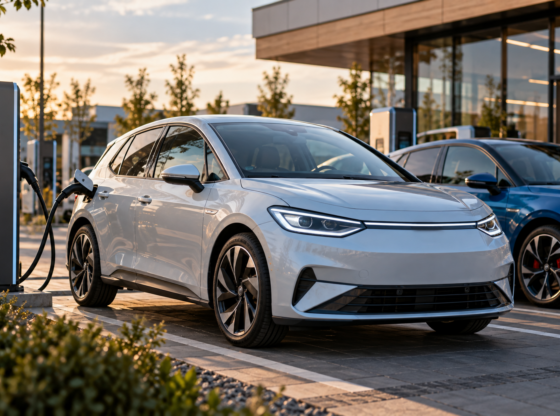

The electric-car market is entering a new phase in 2026. Instead of being defined mainly by a handful of premium models and ambitious technology demonstrations, the latest wave of launches is reaching deeper into everyday segments. Smaller cars, family vehicles, performance models and new urban crossovers are all becoming part of the electric lineup, giving buyers more choice than ever before.
That shift can be seen in the cars arriving on the market this year. Volkswagen has turned its long-established Polo name into a fully electric model, while the ID. Polo GTI brings a performance badge traditionally associated with petrol-powered hot hatches into the battery-electric era. Across Europe, the official vehicle database is also filling with new models and new versions, from compact electric cars to large premium SUVs.
The significance of these launches goes beyond the individual cars. Together, they show how manufacturers are trying to make electric vehicles more varied, more affordable and better suited to different lifestyles.
The Electric Car Market Is Getting More Diverse
For several years, the conversation around electric cars was dominated by range, battery capacity and charging speed. Those factors remain important, but the market has become more sophisticated. Buyers are now comparing electric vehicles much as they compare conventional cars: by size, practicality, design, performance, equipment and price.
That is why the arrival of smaller electric models is particularly important. A large electric SUV can demonstrate what battery technology is capable of, but a compact car priced for ordinary households can have a much broader effect on the market.
Volkswagen’s new ID. Polo is a clear example. The company has positioned the model as an everyday electric car rather than a technology showcase. Depending on specification, it uses either a 37 kWh LFP battery or a 52 kWh NMC battery, with official WLTP range figures reaching approximately 329 km and 454 km respectively. The entry version starts at €24,995 in Germany, while the 37 kWh model is already being offered as a lower-cost alternative.
That pricing matters because it moves the discussion closer to the territory where electric cars have to compete directly with mainstream combustion-powered vehicles.
Volkswagen Is Betting on the Small Electric Car
The ID. Polo is one of the clearest examples of how established manufacturers are adapting familiar names for an electric market. Rather than creating an entirely separate identity, Volkswagen has taken one of its best-known compact models and rebuilt it around an electric architecture.
The strategy is also about efficiency. The ID. Polo uses front-wheel drive and the MEB+ platform, while its compact battery options are designed to keep weight, complexity and cost under control. Volkswagen says the larger-battery version can reach up to 454 km under the WLTP testing cycle, while the smaller battery is intended primarily for everyday urban and commuting use.
The result is a different proposition from the early generation of electric cars, when manufacturers often treated large batteries and long range as the safest way to convince customers to switch. The ID. Polo suggests that another strategy is possible: build a smaller and more efficient car, price it more aggressively and match its capabilities to the way most people actually drive.
The company is extending that idea beyond practicality. In 2026 it also introduced the ID. Polo GTI, the first fully electric model to carry Volkswagen’s famous GTI badge. With 166 kW, or 226 PS, the compact performance model can accelerate from zero to 100 km/h in 6.8 seconds, while pre-sales in Germany are scheduled for autumn at just under €39,000.
It is a useful reminder that the electric transition is not simply about efficiency. Performance cars are also becoming part of the new generation.
More New Models Are Filling the Gaps
Volkswagen is not alone in expanding the number of electric vehicles available to consumers. The European Alternative Fuels Observatory is already tracking a rapidly growing selection of battery-electric passenger cars, with new entries arriving throughout 2026.
The database illustrates how quickly the market is broadening. The Audi A2 e-tron, for example, is listed with a 50 kWh battery and an estimated range of 325 km, while the Škoda Epiq appears in several configurations, including a 51.7 kWh version with a range of up to 320 km. Other new arrivals cover a much wider range of requirements, from compact hatchbacks to large SUVs.
The important development is not that every new model offers extraordinary range. In fact, some of the newer compact cars deliberately use relatively modest battery capacities. That reflects a growing understanding that not every vehicle needs a huge battery.
A small electric car designed primarily for city driving can be lighter, more efficient and cheaper if its battery is sized for its actual role. That approach also reduces the amount of expensive battery material required per vehicle, potentially making electrification easier to scale.
Range Is Still Important, But It Is No Longer the Whole Story
Long driving range remains one of the easiest specifications for consumers to understand. A vehicle capable of travelling 500 kilometres or more between charging stops has an obvious advantage for long-distance drivers.
The newest generation of European EVs shows that manufacturers are continuing to push in that direction. The European vehicle database includes models such as the Audi Q6 Sportback e-tron with a listed range of around 500 km, the Volkswagen ID.7 GTX at approximately 500 km, and the Hyundai Ioniq 6 with up to 545 km in one configuration.
But the market is simultaneously moving in the opposite direction by introducing cars with smaller batteries and shorter ranges.
That is not necessarily a contradiction. It reflects the fact that electric mobility is becoming segmented. A driver who regularly travels long distances has different requirements from someone who spends most of the week commuting through a city. The expanding EV market can now accommodate both.
This may eventually make range anxiety less influential as a universal argument against electric cars. Instead of every model being expected to deliver maximum range, buyers can increasingly choose a vehicle whose battery matches their driving pattern.
Prices Are Becoming One of the Most Important Headlines
The biggest story surrounding many 2026 launches may ultimately be price rather than horsepower or range.
For years, electric vehicles were frequently positioned above comparable combustion models, with manufacturers relying on technology, lower running costs and environmental benefits to justify the difference. The arrival of more affordable compact EVs changes that equation.
The Volkswagen ID. Polo starting at €24,995 in Germany is particularly significant because it demonstrates that a major manufacturer is willing to place an electric model directly in the mainstream compact-car conversation. Volkswagen has also said that its broader electric urban-car family is being developed with an emphasis on affordability and European production.
At the same time, the market is not abandoning premium electric vehicles. New electric SUVs, performance cars and luxury models continue to arrive with large batteries, sophisticated drivetrains and substantially higher prices.
The result is an increasingly normal automotive market in which electric cars exist at multiple price points rather than occupying one narrow premium category.
Concept Cars Are Becoming More Important
Another part of the 2026 EV story is the growing importance of concept and near-production vehicles. Automakers increasingly use these cars not simply to display futuristic design, but to signal what is coming next.
The distinction between concept and production vehicle is therefore becoming particularly important for consumers following EV news. Some vehicles presented at major events may be several years away from dealerships, while others are effectively production cars wearing the language of a concept.
Volkswagen’s ID. Polo GTI is a good example of that transition. The company presented it as a near-production vehicle before announcing its planned sales timeline, making the concept stage part of a much shorter path toward the showroom.
Other manufacturers are taking more radical approaches to design. Jaguar’s newly unveiled Type 01, for instance, closely follows the dramatic appearance of the Type 00 concept. The production electric grand tourer is reported to use a 118 kWh battery, three electric motors producing 1,016 horsepower and a claimed range of up to 400 miles, with orders expected to open in early 2027.
That car occupies a completely different part of the market from an ID. Polo, but its significance is similar: electric propulsion is increasingly being used as the basis for new interpretations of familiar automotive categories.
The Next EV Race Will Be About Choice
The most interesting development in 2026 may therefore be the sheer variety of electric cars entering the market.
There are affordable compact models designed around efficiency, long-range family cars, sporty hatchbacks, premium SUVs and highly experimental luxury vehicles. Some prioritize battery capacity, others concentrate on weight and efficiency, while still others use electric power to create performance figures that would have been difficult to achieve with conventional drivetrains.
That variety is important because the mass adoption of electric cars will not be driven by one perfect model. It will depend on whether manufacturers can produce enough different vehicles to match the realities of different drivers.
The new generation arriving in 2026 suggests that this process is already underway. Electric cars are becoming less of a separate category and more of a complete automotive ecosystem, with different sizes, prices, personalities and technical approaches.
For consumers, that may be the most important change of all. The question is increasingly moving away from whether there is a suitable electric car and toward which electric car makes the most sense for a particular driver.