
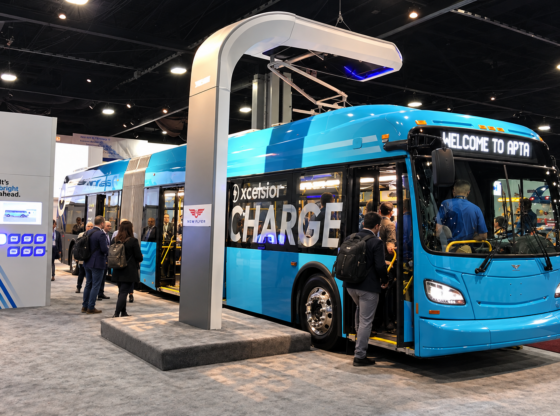

The electric-car revolution is easy to see. New models arrive every month, charging stations are expanding and manufacturers compete over range, performance and battery technology.
The transformation of public transport is quieter, but in many ways it may have a more direct impact on everyday urban life.
Electric buses are moving from pilot projects into regular fleet operations, and the technology is becoming increasingly capable of handling the predictable routes on which city buses operate. Global electric-bus sales reached almost 70,000 vehicles in 2025, an increase of 12% from the previous year. Battery-electric models accounted for 98% of those sales.
The significance of that growth goes beyond the number of vehicles being sold. A city bus travels repeatedly through densely populated areas, often for many hours a day. Replacing a conventional diesel bus with an electric equivalent can therefore affect local air quality, noise and energy consumption on a much more visible scale than the replacement of a single private car.
The technology is also reaching a point where the practical limitations are becoming less significant. The average range of available battery-electric bus models has reached about 360 kilometres, around 15% higher than in 2020. The IEA estimates that this is already sufficient for the typical daily mileage of many urban buses, which generally travel between 150 and 300 kilometres per day.
The question is no longer whether electric buses can work in cities. It is how quickly cities can build the infrastructure and financing systems needed to deploy them at scale.
The Economics of an Electric Bus Are Different
An electric bus is considerably more expensive to purchase than a traditional diesel vehicle in many markets. That initial price remains one of the biggest barriers to rapid fleet conversion.
But public transport operators do not evaluate vehicles in quite the same way as private buyers.
A city bus can operate for years, covering large distances every day. Energy costs therefore become a major part of the vehicle’s lifetime economics. Electric motors are considerably more efficient than combustion engines, and electric buses can recover energy during braking instead of wasting all of it as heat.
Maintenance can also change because an electric drivetrain contains fewer moving mechanical components than a conventional diesel powertrain.
This means that the purchase price tells only part of the story. Operators increasingly have to compare the total cost of ownership over the entire service life of the vehicle.
The IEA notes that declining battery costs and the growing number of electric bus models have helped support the transition, while predictable city routes make buses particularly well suited to electrification.
A bus that returns to the same depot every evening is fundamentally easier to electrify than a long-distance vehicle that may spend an entire day far from a charging facility.
China Still Leads the Global Transition
China remains the largest electric-bus market by a considerable margin.
The country accounted for around 60% of global electric-bus sales in 2025, although its share has gradually fallen from almost 100% in 2018 as other markets have begun adopting the technology more rapidly. More than 60% of all new bus sales in China were electric in 2025, while city buses were almost entirely electric.
That position did not emerge overnight.
Chinese cities have been electrifying public transport for more than a decade, creating an industrial ecosystem in which battery manufacturers, vehicle producers, charging companies and public authorities have developed alongside one another.
The result is a useful demonstration of what happens when fleet electrification is treated as a long-term infrastructure programme rather than a series of isolated vehicle purchases.
Large-scale deployment also creates economies of scale. Manufacturers gain experience producing electric buses in large volumes, operators become familiar with charging and maintenance requirements, and cities can develop standardized approaches to depot infrastructure.
Other regions are now trying to build similar ecosystems, although their starting points are very different.
Europe Is Moving Beyond Pilot Projects
Europe has become the world’s second-largest electric-bus market.
More than 12,000 electric buses were sold in the European Union in 2025, representing a 28% increase from the previous year. Battery-electric city buses accounted for more than 55% of new city-bus sales in the EU, compared with around 45% in 2024.
That growth reflects both regulation and practical experience.
The European Union’s Clean Vehicles Directive has pushed public authorities toward cleaner procurement, while cities have gained more confidence in the operational capabilities of electric fleets.
The results vary significantly between markets, but the overall direction is clear. Some European countries have already moved electric buses from a minority technology to a substantial share of new purchases.
The next challenge is therefore less about proving that electric buses work and more about ensuring that the electricity infrastructure, depots and financing mechanisms can keep pace with replacement cycles.
Charging a Bus Is Different From Charging a Car
The infrastructure required for an electric bus fleet can be considerably more complex than a network of public chargers for passenger cars.
A bus depot may need to charge dozens or even hundreds of vehicles during a relatively narrow overnight window. The electricity connection must therefore be powerful enough to handle substantial simultaneous demand.
Operators also have to decide whether buses should charge primarily at depots or receive additional energy during the day.
For routes that comfortably fit within the vehicle’s available range, overnight depot charging can be the simplest solution. The bus leaves in the morning with a full battery, operates its scheduled route and returns later for another charging session.
More demanding routes may require opportunity charging at terminals or selected stops. In those cases, high-power equipment can provide enough energy during a short break to keep the vehicle operating throughout the day.
The growing range of electric buses makes the first approach increasingly practical. With average available range now around 360 kilometres, many urban routes can be completed without an additional daytime charging stop.
That reduces both operational complexity and the amount of charging equipment required across the network.
Latin America Is Becoming an Important New Market
One of the most interesting developments in the global electric-bus market is taking place outside the traditional leaders.
Electric-bus sales in Latin America more than tripled in 2025, exceeding 3,000 vehicles. The region’s growth was strong enough to account for roughly 30% of the increase in global electric-bus sales that year.
The expansion is particularly significant because public transport already plays a major role in urban mobility across many Latin American cities.
Chile has emerged as one of the region’s strongest adopters. Nearly 2,000 electric buses were sold there in 2025, representing more than one in five bus sales. Santiago now has the largest electric-bus fleet of any city outside China, according to the IEA.
Brazil is also expanding electrification, although adoption remains at an earlier stage. Public investment programmes supporting electric buses and rail vehicles are helping cities begin the transition while manufacturers and operators build local expertise.
These developments demonstrate why electric buses cannot be viewed simply as a European or Chinese technology story. Their economics can be particularly attractive in cities where public transportation already moves large numbers of passengers every day.
The Technology Is Improving, But Coaches Remain Harder
The success of electric city buses should not be confused with a complete electrification of all bus transport.
Urban routes are relatively predictable. Intercity coaches are different.
A long-distance coach may travel hundreds of kilometres between stops and spend much of the day away from its home depot. Charging infrastructure along major routes must therefore become reliable enough to support commercial schedules, while the vehicle needs enough battery capacity without sacrificing too much passenger or luggage space.
The IEA estimates that few currently available electric buses can meet the requirements of intercity routes that may reach 800 kilometres per day. Some manufacturers are already pushing the technology further, with King Long offering electric intercity buses capable of around 650 kilometres of claimed range.
This distinction is likely to remain important for years.
Urban buses are becoming one of the clearest early wins for electrification because their routes are predictable and their vehicles return to known locations. Long-distance coaches require a much broader charging network and more careful scheduling.
The transition will therefore probably happen at different speeds across different parts of the bus industry.
Electric Buses Can Change the Sound of a City
The environmental argument for electric buses is not limited to carbon emissions.
Noise is one of the most immediate differences passengers and pedestrians can notice.
A diesel bus accelerating from a stop creates engine noise, vibration and exhaust emissions directly beside people walking along the street. An electric bus is significantly quieter at low speeds and eliminates tailpipe emissions entirely.
That can make a noticeable difference in dense urban environments where buses operate continuously throughout the day.
The effect is particularly relevant around residential streets, schools, hospitals and pedestrian-heavy areas. Cleaner public transport can therefore improve the quality of the urban environment even before the electricity used to charge the buses becomes fully renewable.
This is one reason cities often view public-transport electrification as a broader urban-quality project rather than simply a climate policy.
Fleet Electrification Changes the Depot Too
The transition to electric buses affects more than the vehicles themselves.
A traditional bus depot is primarily a place for parking, maintenance, refuelling and cleaning. An electric depot increasingly becomes an energy-management facility.
Operators need charging hardware, electrical distribution systems, software to schedule charging and ways to monitor the condition of hundreds or thousands of batteries over time.
The timing of charging can also become economically important.
If a fleet charges every vehicle simultaneously when electricity demand is high, the operator may face unnecessary grid costs or require a much larger electrical connection. Smart charging can spread demand across the night and prioritize vehicles according to their next scheduled departure.
This creates a new relationship between public transport and the electricity system.
A bus fleet is no longer simply a consumer of fuel. It becomes a large, controllable electricity load that can potentially be coordinated with the wider grid.
The Next Challenge Is Making Fleets Interoperable
As electric buses become more common, another issue is gaining importance: standardization.
Cities do not want to be locked into one manufacturer’s charging system or forced to redesign their infrastructure every time they purchase a new generation of vehicles.
Common charging standards, interoperable software and reliable data are therefore becoming increasingly important.
The broader sustainable-mobility transition depends on the same principle. Buses, trains, bicycles, cars and shared mobility services need to function as parts of a connected transportation system rather than isolated products.
The European Union’s latest urban-mobility policy direction reflects this shift. In July 2026, the European Commission adopted a common set of urban mobility indicators covering sustainability, safety and accessibility, with the aim of giving cities and national authorities better data for transport planning.
That may sound like an administrative development, but better data can influence very practical decisions: where new bus lanes are needed, which routes require more capacity, where charging infrastructure should be installed and how effectively different transport modes are serving passengers.
Electric Buses Are Part of a Bigger Urban Transformation
The strongest case for electric buses is not simply that they are cleaner versions of diesel buses.
They can become part of a different urban transportation model.
A city that replaces diesel buses with electric vehicles can simultaneously improve charging infrastructure, redesign depots, introduce cleaner bus lanes and integrate public transport more closely with cycling and pedestrian networks.
That is where electrification begins to have a wider effect.
The European Commission’s updated Sustainable Urban Mobility Planning guidelines, published in 2026, emphasize integrated, inclusive and efficient urban transport planning. The revised framework also includes specific guidance on incorporating cycling into broader mobility plans.
The underlying principle is straightforward: cleaner vehicles are most effective when they operate inside a well-designed transportation network.
An electric bus stuck in the same congestion as every other vehicle has environmental advantages, but it does not solve the problem of inefficient urban movement. A reliable electric bus operating in a well-connected public transport network can do much more.
The Bus May Become One of the Most Important EVs
The electric-car industry will continue to dominate headlines because passenger vehicles are highly visible and new models attract enormous consumer attention.
But electric buses may ultimately have a more direct influence on sustainable urban mobility.
One vehicle can replace a large amount of diesel consumption, operate repeatedly every day and carry dozens of passengers. The technology is already mature enough for many city routes, and global sales are rising quickly. Almost 70,000 electric buses were sold worldwide in 2025, with sales increasing across Europe and particularly rapidly in Latin America.
The next stage will be about scale.
Cities will need to replace aging fleets, expand depot charging, strengthen electricity connections and train technicians. They will also need to make sure that new electric buses are supported by good routes, reliable schedules and infrastructure that allows public transport to compete with private cars.
That is why the electric-bus transition deserves to be viewed as more than another chapter in the EV story.
It is part of a broader transformation in how cities move people. The most sustainable vehicle may not always be the one parked outside a home. In many urban journeys, it may be the electric bus carrying dozens of people through the same streets every day.
As battery technology improves and charging infrastructure becomes easier to manage, that role is likely to grow. The next generation of sustainable mobility will not be built around one type of vehicle. It will depend on making the vehicles that already move large numbers of people cleaner, more efficient and better connected to the cities they serve.